

THE ARGUMENT IN BRIEF
Useful content can inform an AI answer without strengthening the brand that created it. Anil asks what survives between expertise, attribution and the customer’s decision, and how marketers can test the commercial value of inclusion.
Your team commissions an excellent guide. It explains the category, answers difficult customer questions and draws on expertise your business has spent years developing.
An AI system uses it to answer a prospective buyer. The answer is useful. The customer understands the issue and moves on.
Your content worked. Did your marketing?
That question deserves a place beside the growing enthusiasm for generative engine optimisation. Being included in an AI answer can be valuable. But inclusion describes something the system did. It does not establish what the customer remembered, preferred or bought.
A brand can contribute knowledge to an answer without capturing much commercial benefit from it. Before celebrating visibility, I would ask what survived the journey from your content to the customer’s decision.
The answer may travel further than the brand
Consider a hypothetical Indian sunscreen brand.
It publishes a well-researched explanation of SPF, application quantity and reapplication. A customer asks an AI assistant which sunscreen to buy for a humid commute. The assistant draws on the guide, combines it with other sources and explains the relevant considerations.
Perhaps it names the brand. Perhaps it cites a link the customer never opens. Perhaps the eventual purchase happens on a marketplace, where price and delivery determine the final choice. Several outcomes are possible.
The content might have built trust in the brand. It might have improved understanding of the entire category. It might have helped a competitor whose product was easier to purchase.The website session would reveal only part of that story. This is why I would resist two convenient conclusions: that a citation proves success, or that a missing click proves failure.
Both skip the commercial question.
What the research establishes
Pew Research Center’s July 2025 analysis found lower outbound clicking when Google searches displayed AI summaries. It observed behaviour in a US browsing panel, rather than randomly assigning people to identical searches with and without summaries. The association deserves attention; causal claims require care. Read the research. Pew Research Center
A newer research preprint takes a different approach. Revised in October 2026, it examines Wikipedia search referrals around AI Overview rollout, using comparisons across language editions. The authors estimate a reduction in English referrals. Its setting and assumptions matter, and the result cannot be transplanted directly into a brand’s sales forecast. Read the paper. arxiv.org
Together, these findings justify scrutiny of referral economics. They do not tell us whether a particular brand lost demand, gained influence or simply acquired a different customer journey. That distinction should shape the measurement brief.
Who owns the benefit of a useful explanation?
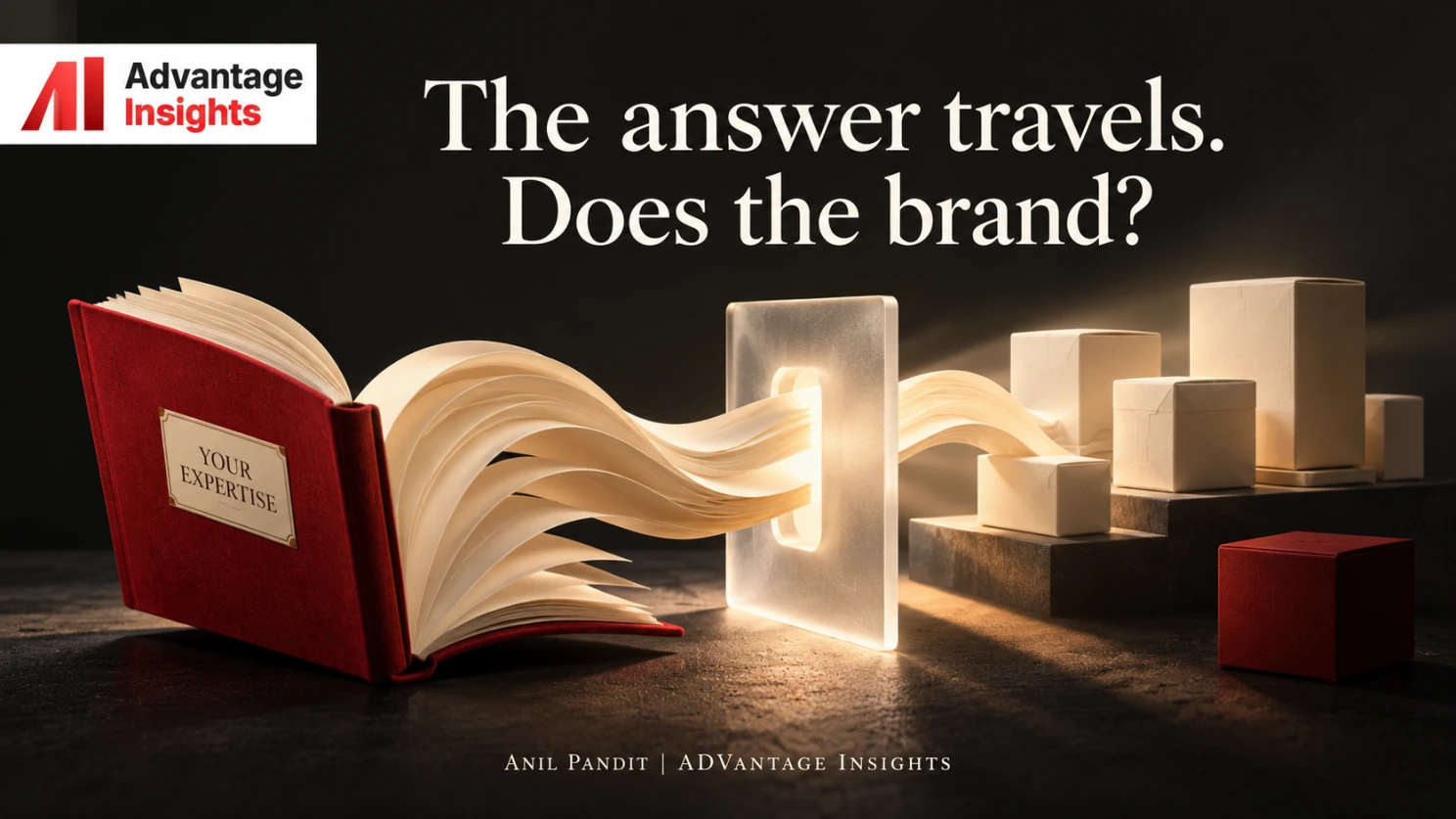
Marketers have always published educational content partly to grow a category. There is nothing inherently wrong with that. A market leader may benefit disproportionately when more people understand and buy the category.
A challenger might make a different calculation. If its expertise is absorbed into a general answer while its distinctive proposition disappears, the business may be funding education from which larger competitors benefit.
That is a hypothesis, not an established industry-wide effect. But it exposes an overlooked strategic variable: the brand’s position in the category. The same content outcome could be commercially sensible for one advertiser and disappointing for another.A GEO recommendation that ignores this difference is incomplete.
Make expertise attributable
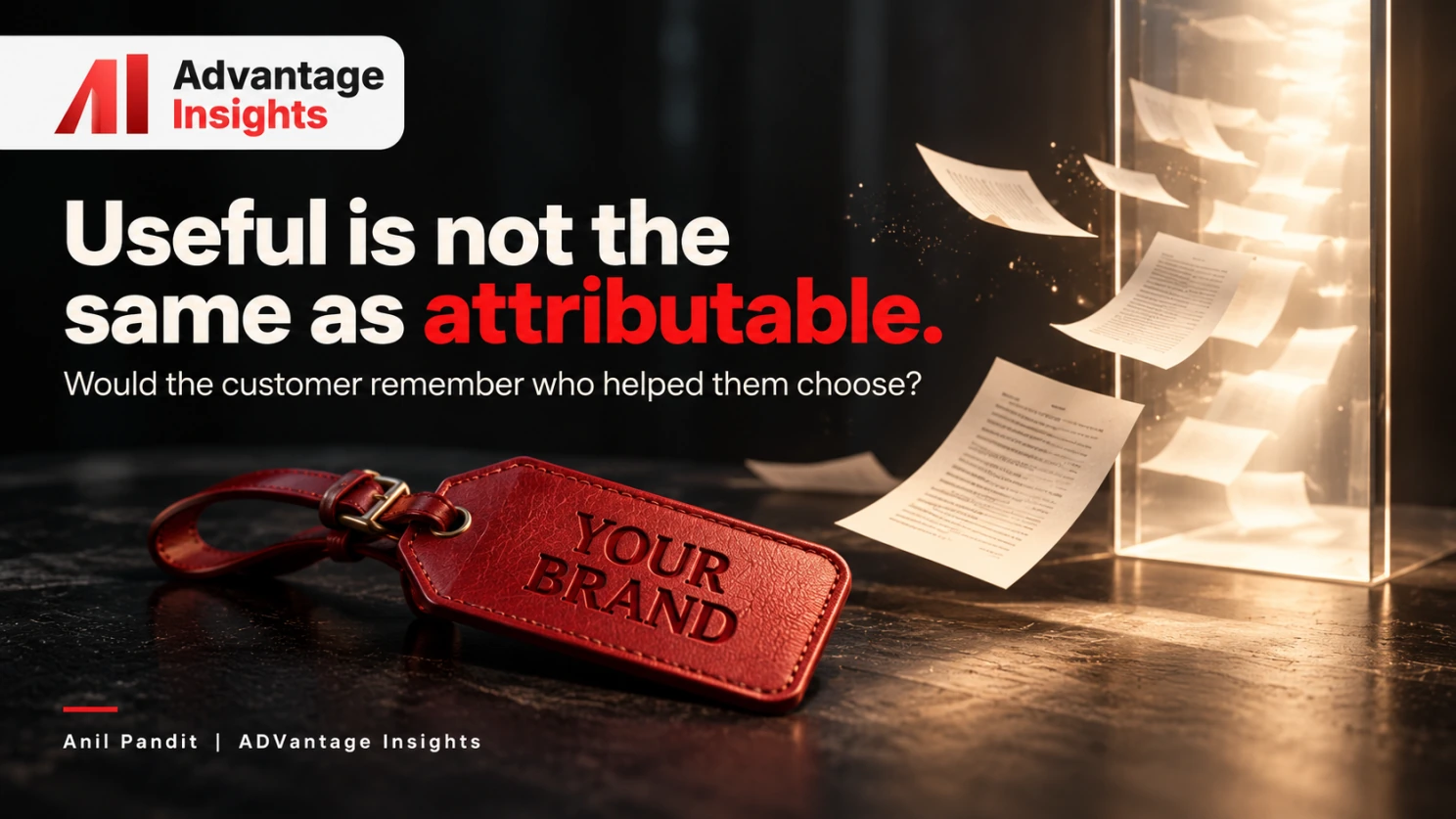
The tempting response is to attach the brand name to every paragraph. That will not make weak content distinctive.
I would examine whether the material contains something customers have a reason to associate with its source: original research, a useful diagnostic, a clearly explained product capability, or evidence that helps resolve a consequential choice.
None guarantees an AI recommendation. None guarantees that attribution survives summarisation. They do, however, give the team something meaningful to test.
When customers encounter the resulting answer, do they remember who supplied the useful idea? Does it change their understanding of the brand? Can they explain why they would choose it?
A citation count cannot answer those questions.
India makes website-only measurement particularly incomplete
Imagine the sunscreen customer buys through quick commerce after reading an AI answer. The brand’s website may receive no visit. The commercial effect could still be positive. Alternatively, the customer may absorb the brand’s advice and buy a cheaper substitute.
The same absence of a website conversion could conceal two very different outcomes. For an Indian brand selling across its own store, marketplaces, quick commerce and physical retail, the measurement boundary must reflect where business actually happens. This does not mean every content programme needs an elaborate attribution model.
It means teams should state what they can observe and what remains unknown, rather than treating measurable website activity as the entire outcome.
Give the content portfolio a commercial test
Start with a small set of important customer questions.
Compare what AI systems say, which sources they use and whether your distinctive proposition remains visible. Repeat observations because outputs can vary. Then test customer response separately. Use appropriately designed research to examine recall, consideration and understanding after exposure to representative answers.
For larger investments, investigate business effects through a credible experimental design where feasible. Do not claim causality from a rise in mentions followed by a rise in sales.
Google has introduced participation controls and visibility reporting for its generative search features. Those tools can support observation, but they cannot replace the commercial evaluation. The practical decision is not to withdraw useful information indiscriminately.
It is to identify which content builds preference, which supports customer service, which grows the category and which costs more than its demonstrated contribution warrants.
Before funding another hundred AI-visible pages, ask: if the customer remembers the answer and forgets the source, who benefits from your investment?
Anil Pandit
FROM THE AUTHOR’S ARCHIVE
First published by Anil Pandit on LinkedIn on 3 November 2026. Original wording and available illustrations are reproduced from that edition. Claims and references reflect the time of writing.
View on LinkedIn ↗What does this mean for your business?
Bring the question into a focused advisory conversation.
Work with Anil ↗