

THE ARGUMENT IN BRIEF
Custodial Intent describes the rich needs people disclose to AI assistants while brands see only fragments. Anil maps the custody chain and shows where marketers can earn direct, permissioned insight.
Picture this. It is 11:40 pm. A mother in Mumbai types into an AI assistant:
"My 6-year-old has eczema. We fly to Goa on Friday. Which sunscreen won't make it worse, costs under 500 rupees, and can reach me in Bandra before morning?"
Count what is inside that one sentence. A child's age. A skin condition. A travel date. A budget. A location. A delivery window. A fear.
No form ever collected that. No CDP. No loyalty programme. No cookie, living or dead.
And the brand whose sunscreen she finally buys will never read a single word of it.
For over a decade, I have told brands that first-party data is the moat. Earn it, don't buy it. Build the relationship. I still stand by every word. But I have reached a conclusion that makes me uncomfortable, and I suspect it will make a few boardrooms uncomfortable too:
The most honest consumer signal ever created is forming somewhere brands cannot reach. And our industry is still busy collecting mobile numbers.
People finally started telling the truth. To a machine.
Consumers have never been fully honest with brands. They tell a form what the form wants to hear. Search was more honest, but it was shorthand: "sunscreen kids SPF 50".
Conversation is different. When people talk to an AI assistant, they explain. They share context, constraints, doubts, budgets and deadlines. The chatbot is the first commercial interface where people think out loud.
That is intent at a resolution marketing has never seen. Reported figures put ChatGPT at around 900 million weekly users, with roughly one in five conversations carrying shopping intent. Treat those numbers as directional; they come from secondary reporting of OpenAI's statements, not an audit.
So here is the question nobody at the ad-tech conference buffet wants to ask: who owns that intent?
Not you. Meet Custodial Intent.
The "LLM ads will save performance marketing" crowd tends to skip one detail. OpenAI says advertisers do not get access to chats, chat history, memories or personal details. They receive aggregate numbers such as views and clicks.
That is the right privacy call. It also means the intent was never yours. You can rent the space next to it. You cannot hold it.
I call this Custodial Intent.
Custodial Intent: consumer intent that is expressed to, and held by, an AI system acting on the consumer's behalf. Visible to the custodian. Invisible to the brand.
Anyone who has owned crypto will recognise the logic. A custodial wallet means someone else holds your asset and you trust them with it. Consumers now keep their commercial intent in custodial wallets run by a handful of AI companies. Brands are not even the account holder. They are the shop across the road, reading footfall.
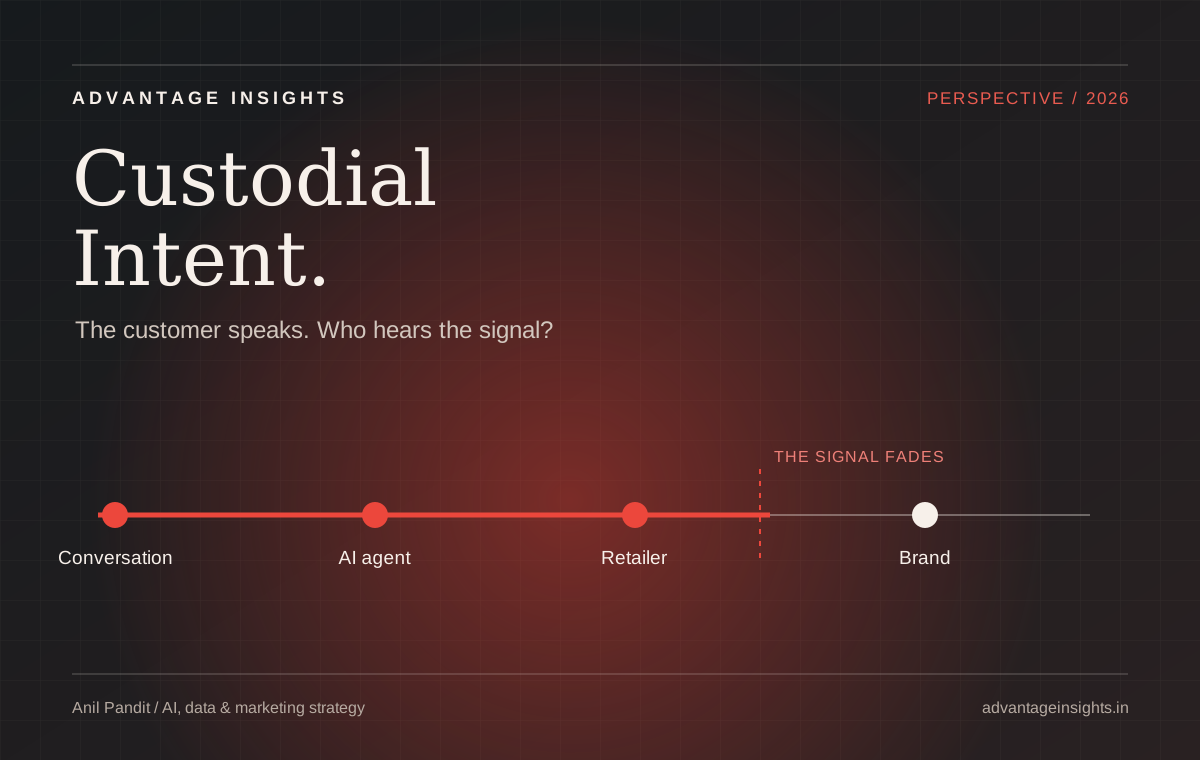
Look at how the ladder has moved:
Every step got more honest. The newest step moved away from the brand. That twist is the whole story.
Intent travels. Follow the chain.
Custodial Intent does not sit still. Once a consumer hands it to a machine, it moves through a series of custodians before anything is bought. I call this the Intent Custody Chain.
At every hop, fragments leak onto surfaces a brand can own, if it bothers to look. I call these fragments Intent Residue.
A person either clicks through or lets an agent act; both paths meet at the retailer, and the brand hears last.
Hop 1: The Conversation
Custodian: the AI platform. Residue that reaches you: aggregate ad statistics. Almost nothing.
What you can do is audit machine belief: what the model believes your category is for, and where it places you. But hold on to this distinction, because most AEO and GEO reporting blurs it. Machine belief is the gatekeeper's opinion. It is not consumer intent. Optimise for one while believing it is the other, and you will serve the wrong master very efficiently.
Ask your team: do we know what the assistant thinks our brand is for?
Hop 2: The Arrival
When an assistant sends a person to your page, the page it picks is the conversation's conclusion, compressed into a URL. Most analytics stacks log it as a session. It is closer to a verdict.
HubSpot's 2026 State of Marketing report says 58% of marketers find AI referral traffic carries much higher intent. That is a perception survey, not a measurement, but the direction matches what I hear in client rooms.
The move: the Intent Handoff. Ask arriving visitors one question. "What did your assistant tell you about us?" In one line, custodial intent becomes declared, zero-party data, shared on the consumer's own terms.
Ask your team: are we treating AI referrals as traffic, or as testimony?
Hop 3: The Agent Query
In agentic commerce, the consumer does not visit anyone. Their agent queries product catalogues across retailers, comparing attributes, prices, availability, reviews and delivery.
If you host the endpoint (a catalogue API, a product feed, an MCP server), every query that agent sends is a machine translation of the consumer's constraints. And the logs are yours.
The most valuable log line is the one most teams delete: the query that returned nothing. "Fragrance-free, reef-safe, under 400 rupees, delivered in 10 minutes" with zero results is not an error. It is an unmet-demand brief no consumer panel will ever write for you.
Ask your team: who in our company reads the queries that returned nothing?
Hop 4: The Transaction
Custodian: the merchant of record. In current agentic commerce models, retailers remain the merchant of record and keep the revenue and customer data.
Meanwhile, the payments industry is quietly building a chain of custody for intent. Mastercard's Verifiable Intent records the cardholder's instructions to the agent and the agent's interaction with the merchant.
Payments people built it to fight fraud. Marketers have not noticed that the same chain carries the richest demand signal ever produced.
Ask your team: does our retail media contract say anything about agent instruction data?
Hop 5: The Consumption
This is where first-party data still lives: packaging, QR codes, subscriptions, service, repeat purchase. It still matters. It just has a new job, which I come to below.
The FMCG problem nobody has priced yet
For a D2C brand, the chain is short: model, agent, brand.
For FMCG it looks like this: model, agent, marketplace or quick commerce platform, and only then the brand. By the time intent reaches a Unilever or a Procter & Gamble , it has passed through two or three custodians. The brand is last in line for the most important signal in its own category.
Here is my prediction, and I label it clearly as a prediction: retail media networks will package agent instruction data as their next premium product. Something like "shoppers whose agents asked for fragrance-free SPF under 400 rupees in the last 7 days." Brands will then pay to access residue from their own category.
The window to negotiate intent-data rights in joint business plans and retail media deals is now, before it has a rate card.
First-party data is not dead. It changed jobs.
Let me be precise, because this is where lazy takes will go wrong. "Forget first-party data, chase LLM intent" is bad advice. First-party data is losing value as an insight source, and gaining value in three other jobs:
- Access key. Walled gardens match your customer lists against their users. Some agency commentators report ChatGPT plans similar audience matching; OpenAI has not confirmed this, so watch it rather than bank on it.
- Verification. When the decision happens inside a conversation your attribution will never see, your own data is how you prove outcomes.
- First-Party Truth. The new first-party asset is not what you know about the customer. It is what the machine knows about you. Agents deprioritise merchants whose product data is incomplete or inconsistent.
For ten years we asked: what do we know about the customer? The next ten will ask: what does the machine know about us, and is it true?
The consumer side: Intent Self-Custody
People confide in chatbots in ways they never would in a form. Health worries. Money problems. Relationship trouble. Custodial Intent is more intimate than any PII field we have ever argued about.
That intimacy now sits with a small number of custodians, governed by their policies rather than by any consent a brand collected. Privacy professionals should be asking harder questions here than they currently are.
The counter-move is what I call Intent Self-Custody: consumers holding their own intent and choosing, deliberately and revocably, whom to share it with. GDPR already gives people a portability right over data they provide. Whether chat histories fall neatly under it will be argued by lawyers far more expensive than me.
The brand opportunity is simple and old-fashioned. Invite people to bring their intent, with an honest value exchange, and you will earn the richest zero-party data in history. It is the principle I have argued for years. Earn it. Only the address has changed.
What I would do tomorrow morning
- Map your custody chain. For each top category, count the hops between the consumer's conversation and your brand.
- Treat AI arrivals as testimony. Tag LLM referrals separately, map which pages they land on, and add the Intent Handoff question.
- Publish machine-readable product truth through feeds, APIs or MCP servers, and log every agent query, especially the failed ones. Send the zero-result report to R&D and category teams as well as e-commerce.
- Write an intent clause into your next retail media or JBP negotiation: aggregated access to agent instruction data for your category.
- Split your AEO and GEO dashboards. Machine belief on one, consumer intent on the other. Never the same chart.
- Rewrite the business case for first-party data around access, verification and truth, not insight alone.
Four questions to take into your next leadership meeting
- If your best customer described their problem in detail today to a machine, would anyone in your company know?
- Who in your organisation owns the intent you can never own?
- Is your agency buying media, or buying custody?
- When the agent is the shopper, who exactly is your customer?
I spent years telling brands to earn data instead of acquiring it. The principle survives. The address has changed. Intent is now held in custody, and the brands that win the next decade will learn to read the residue, negotiate the chain, and earn the right to be told directly.
I would love to hear where you disagree. That is usually where the next idea starts.
FROM THE AUTHOR’S ARCHIVE
First published by Anil Pandit on LinkedIn on 29 September 2026. The cover visual on this page was created for ADVantage Insights.
An illustration in the LinkedIn edition is not reproduced here. Open the original to view it.
View on LinkedIn ↗What does this mean for your business?
Bring the question into a focused advisory conversation.
Work with Anil ↗