

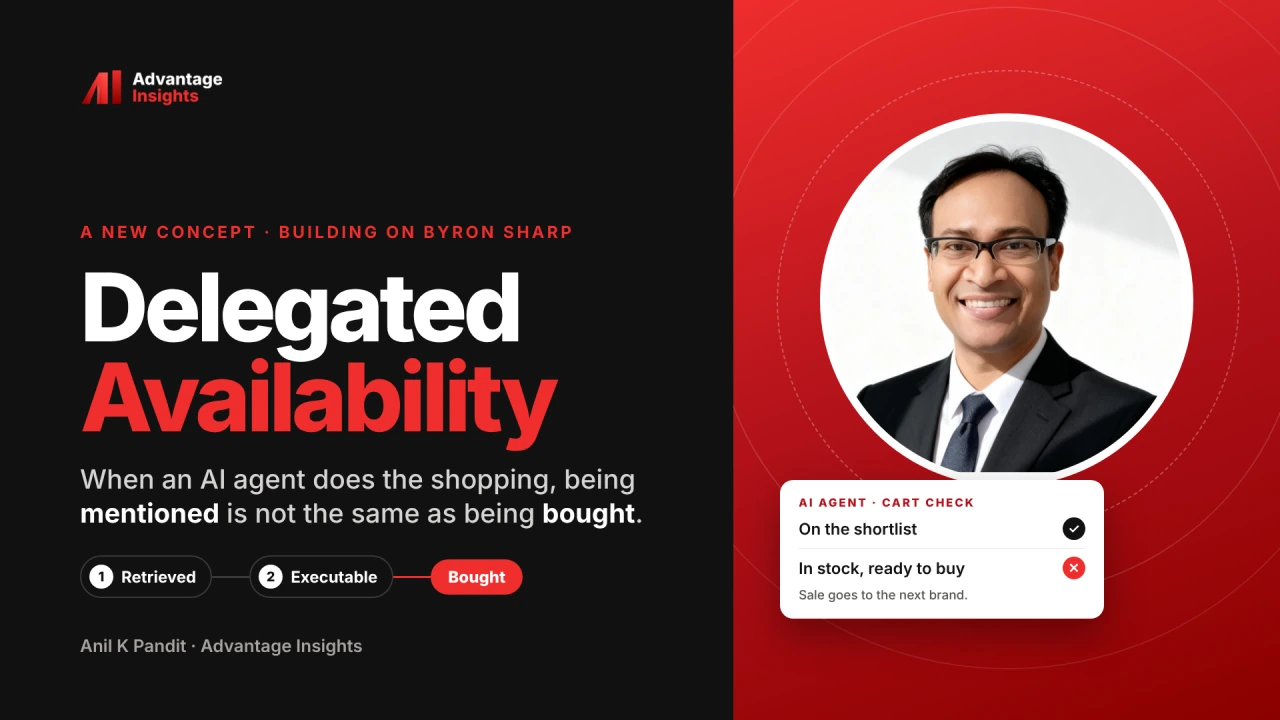
THE ARGUMENT IN BRIEF
A brand can be famous and recommended yet still fail to reach the basket. Anil introduces Delegated Availability to examine whether an agent can find, compare and buy a product, and distinguishes the framework from hypotheses needing validation.
When a shopper hands the purchase to an AI agent, a brand can be famous, recommended, and still not get bought. I call the condition that decides this ''Delegated Availability.''
The moment nobody is measuring
Picture a Tuesday night in Noida. Someone types into an assistant: "Restock the usual. Atta, detergent, the biscuits the kids like. Cheapest delivery before 9."
No aisle is walked. No shelf is scanned. No logo is seen. Within seconds, an agent has read listings, checked stock, compared prices and filled a cart for approval.
Byron Sharp 's How Brands Grow gave us two laws for that moment. Mental availability: is the brand likely to come to mind in a buying situation? Physical availability: is it easy to find and buy when it does?
Both laws assumed a human was doing the finding and the buying. That assumption is now only partly true. A growing share of the buying is being delegated. The agent recalls, filters, compares and sometimes executes.
This piece makes one claim and one bet.
- 🔴 The claim is a measurement: physical availability needs a delegated layer, and it can be counted.
- 🔴The bet is a hypothesis: delegation may bend some of Sharp's own empirical laws. I'd like both to be tested, including by the people best placed to break them.
Credit where it is due
I am not the first to connect Sharp to AI, and I won't pretend otherwise.
- Sharp himself floated "AI availability" in a LinkedIn comment, according to Andrew Holland in Search Engine Land (November 2025). Holland frames it as a third availability: the likelihood an AI system recommends your brand when a user is ready to buy.
- Blackbox Research in Singapore argues in "The Machine-Readable Shelf" (July 2026) that what an agent reads is, in effect, its shelf. Their view: agents don't change the laws of growth, only the work of being available.
- Toluna's AI-in-marketing paper (July 2026) proposes mental, physical and AI availability as three things brands must now build.
I agree with much of this. My quarrel is narrower. Most of what is being measured under "AI availability" is whether a model mentions a brand. That is mental availability in a new venue. It tells you the brand came to the machine's mind. It does not tell you the brand could be bought.
Delegated Availability: Mentioned is not bought
Delegated Availability is the likelihood that, when a purchase is delegated to an AI agent, a brand is both retrieved and executable at the moment the agent acts.
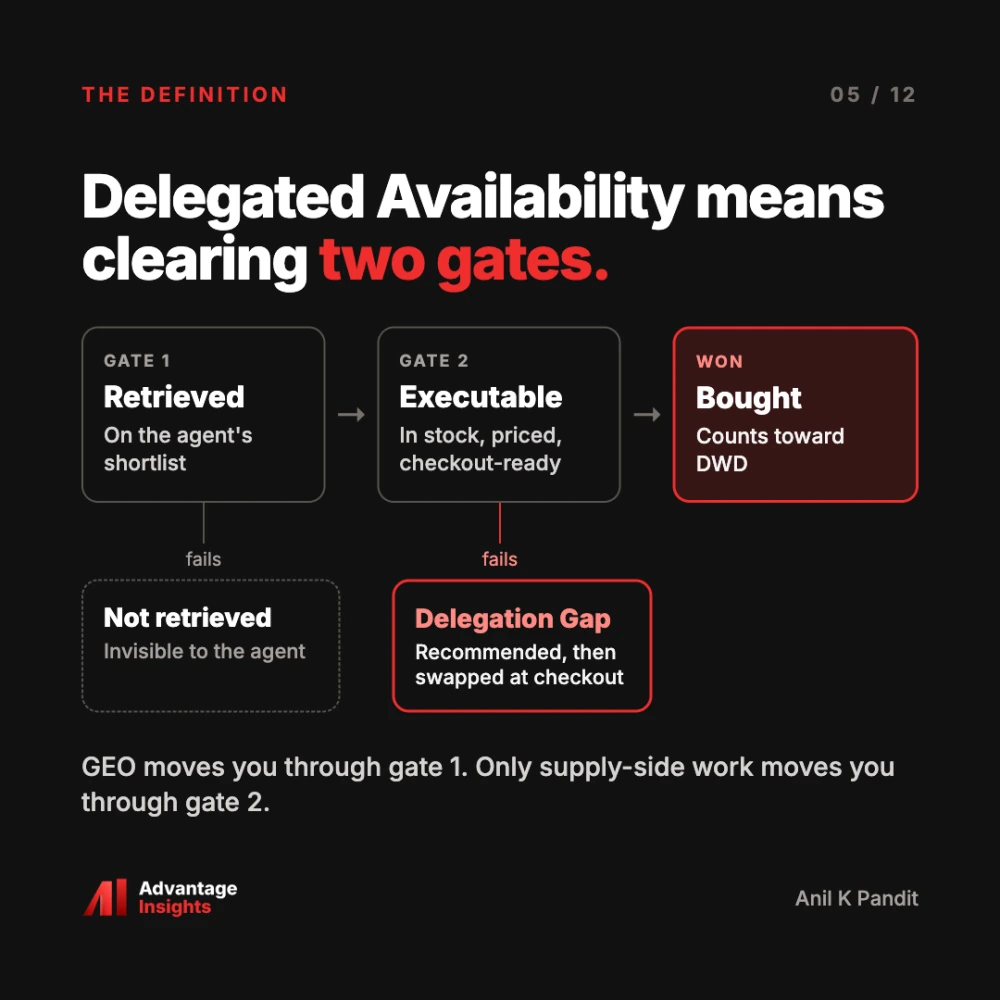
It has two gates, and a brand must clear both.
- Retrieved. The agent puts the brand in its shortlist for that occasion. This is where GEO, citations and structured data do their work. It sits closest to mental availability.
- Executable. The agent can actually complete the purchase. The SKU is in stock at the right dark store or pin code, priced, on a checkout protocol the agent can use, and allowed by the platform's rules. This is pure physical availability.
A brand can clear the first gate and fail the second. It gets recommended, then swapped at checkout for whatever was in stock.
I call that leak the Delegation Gap: demand the machine created for you and handed to someone else.
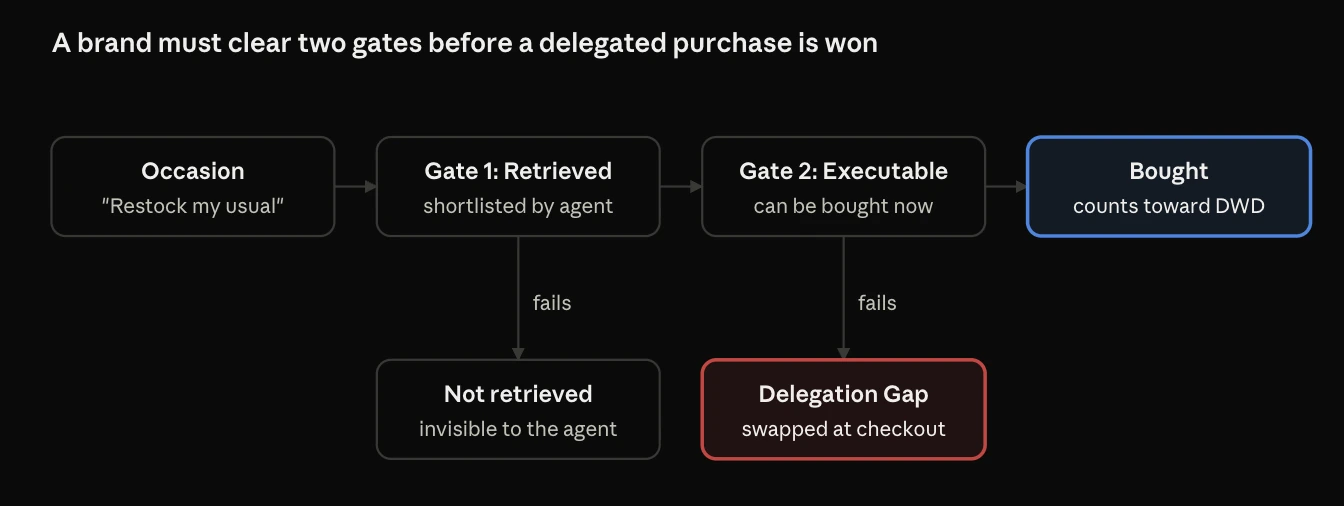
GEO work moves a brand through the first gate. Only supply-side work moves it through the second.
In India this second gate is not theoretical. Quick commerce runs on thousands of dark stores, each with its own assortment and stock. The same brand can be executable in one pin code and absent two kilometres away.
Flag one: Delegated Weighted Distribution
Delegated Weighted Distribution (DWD) is the share of a category's delegated purchase occasions, weighted by their demand, in which a brand clears both gates.
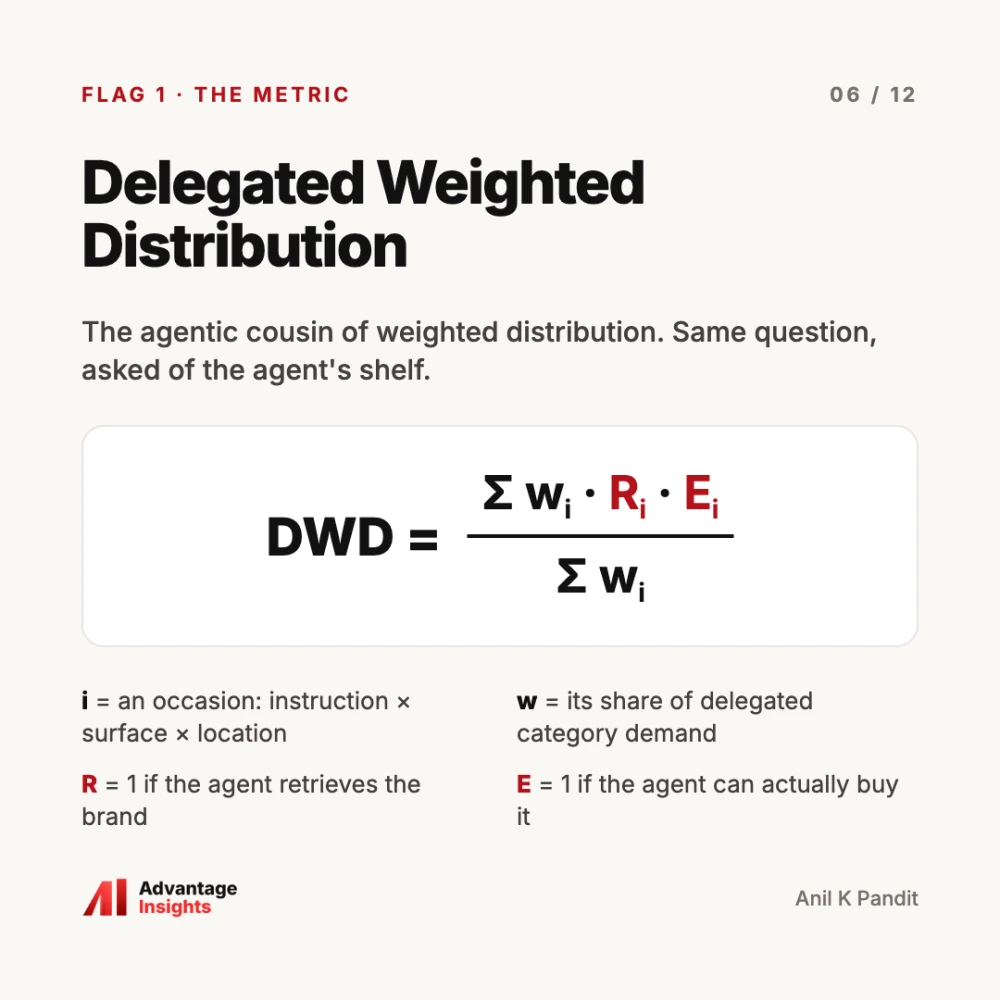
Every FMCG sales head knows weighted distribution: the share of category sales flowing through stores that stock the brand. DWD asks the same question of the agent's shelf. An "occasion" replaces the store: a buying need, phrased as an instruction, on a surface, in a location.

Here i is an occasion, w its share of delegated category demand, R = 1 if the brand is retrieved, and E = 1 if the agent could buy it.
A worked example (illustrative numbers, not data). A hypothetical atta brand, five occasions:
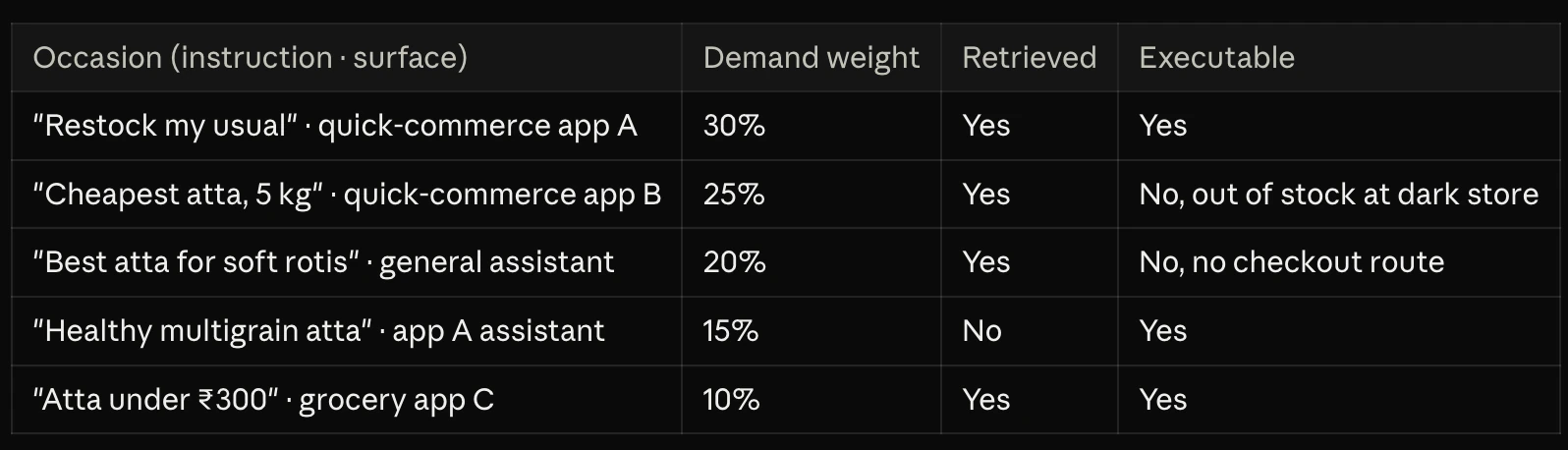
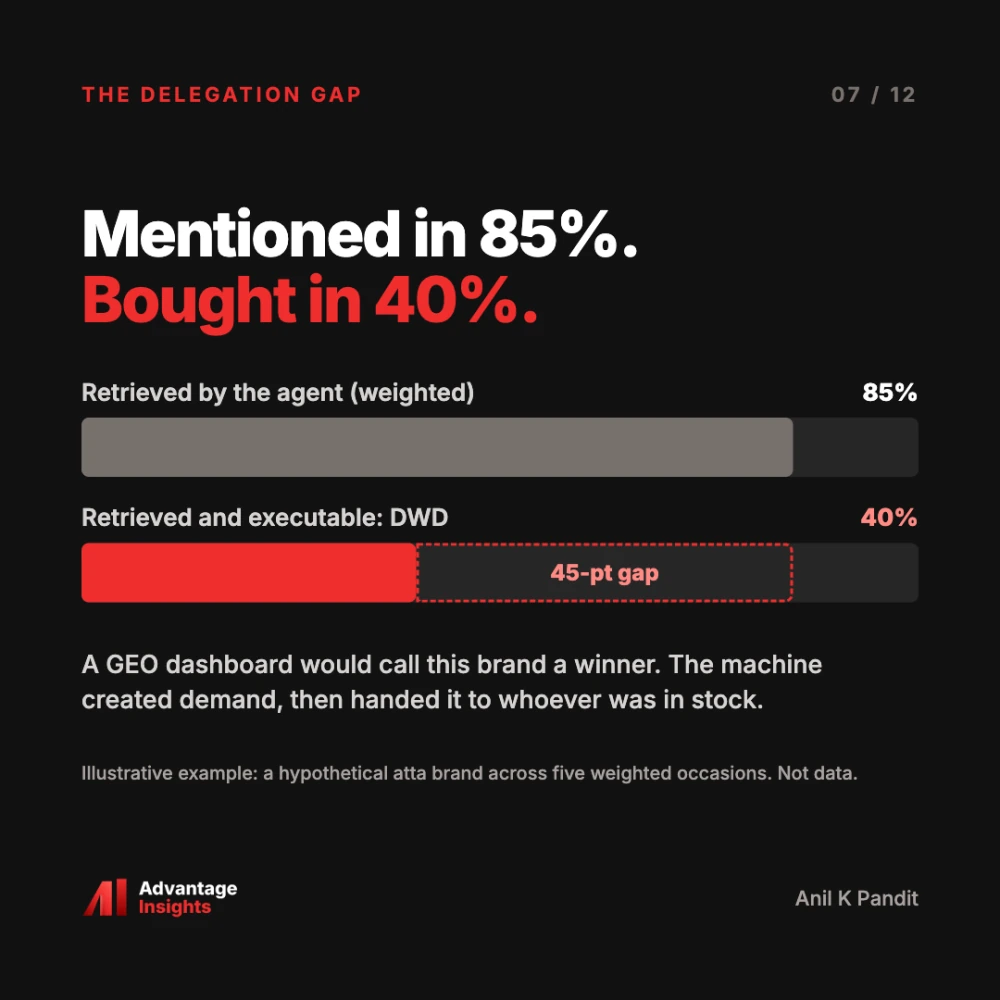
The brand is mentioned in 85% of weighted occasions, which would look excellent on a GEO dashboard. Its DWD is 40%. The Delegation Gap is 45 points: demand the machine created and could not convert.
How to measure it in practice:
- Build an occasion panel: category entry points × instruction types × surfaces × locations (pin codes matter for quick commerce).
- Probe each occasion on a schedule and record whether the brand is shortlisted.
- For shortlisted occasions, check executability: stock, price, checkout route, platform eligibility.
- Weight occasions by demand. Start with equal weights if you must; refine with platform, search or panel data.
- Report DWD and the Delegation Gap side by side, weekly, by surface and city.
Flag two: Instruction Partitioning, a hypothesis
My bet: when buying is delegated, the instruction the shopper gives splits the market into separate contests, and Sharp's loyalty laws may not hold evenly across them.
The Ehrenberg-Bass laws are among the best-replicated findings in marketing.
- Double Jeopardy says smaller brands have fewer buyers, and those buyers are slightly less loyal.
- The NBD-Dirichlet model predicts repeat buying and switching from little more than market share. It works because, in most categories, the market behaves as if it is unpartitioned: brands share customers roughly in line with their size.
Where it deviates, the institute has a name for it, ''excess loyalty.''
An agent does not shop the way a human does. It follows an instruction. Blackbox's survey of 1,050 consumers in mainland China, Hong Kong and Taiwan found preferences split roughly three ways. Each one sets up a different contest:
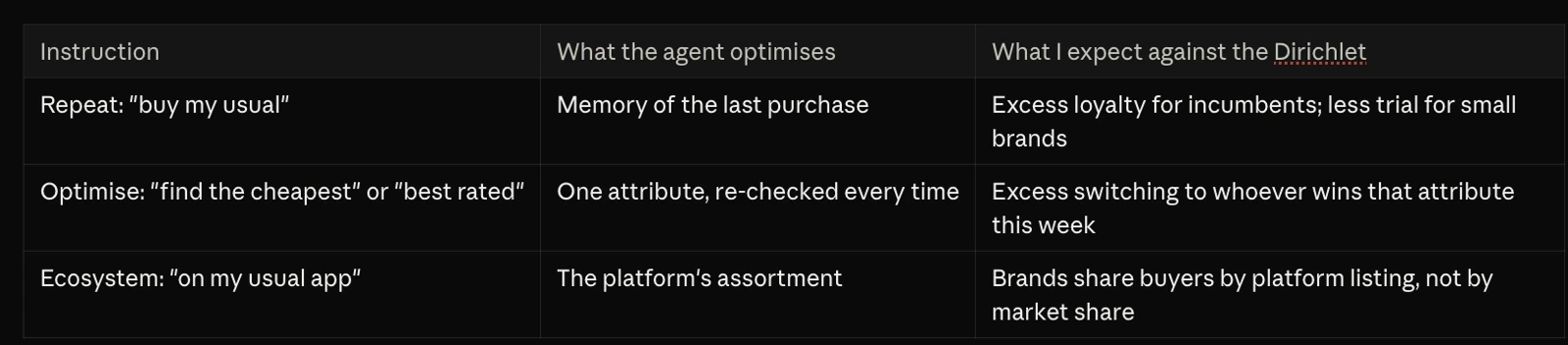
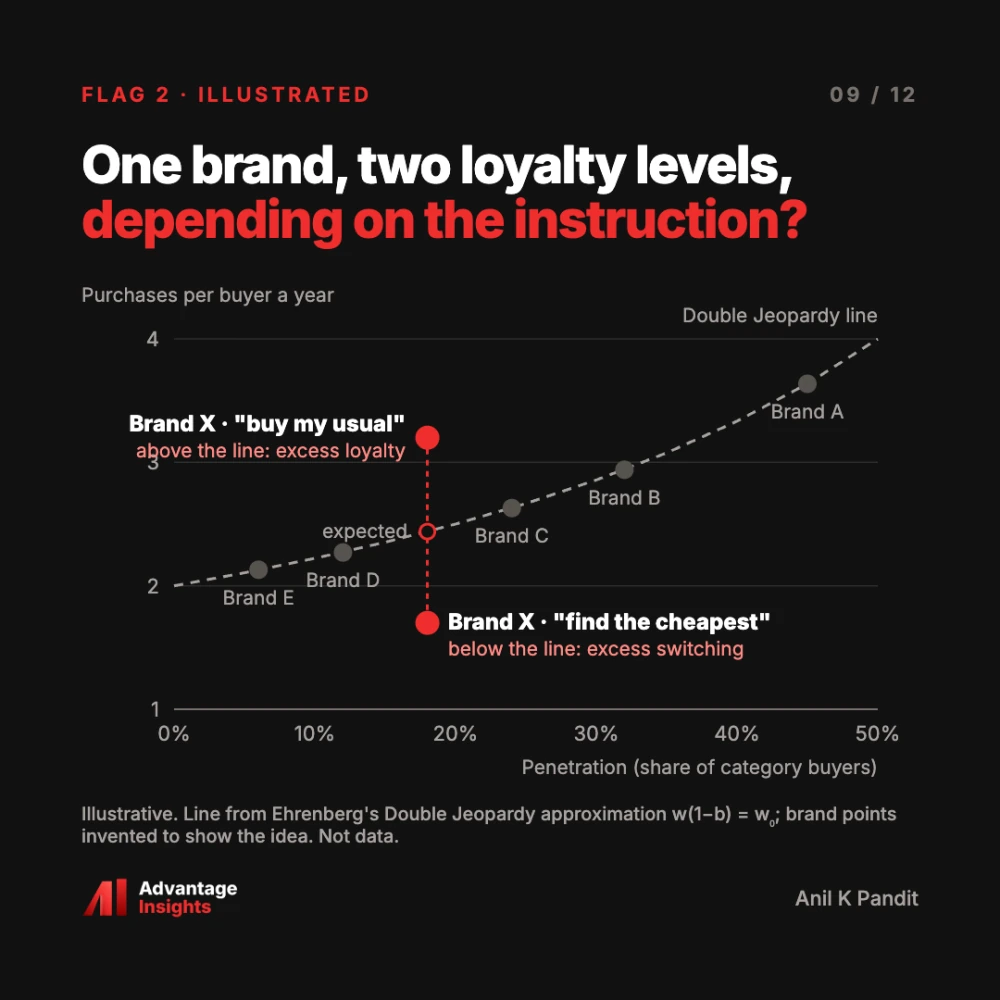
If this holds, the same brand could sit above the Double Jeopardy line among repeat-instructed buyers and below it among optimise-instructed ones.
What would prove me wrong: delegated purchases fit the Dirichlet as well as human ones, at every share of delegation. That is entirely possible. It is also testable: platforms and panel owners that log instructions alongside purchases hold the data today.
The strongest case against me
Sharp's camp would say this is the old story in new clothes. Supermarkets, e-commerce and subscriptions were each supposed to break buying behaviour, and the Dirichlet held.
They would add three fair points:
- Delegation is still small. Even with agentic checkout live on several platforms, most purchases are still made by humans. A deviation in a thin slice won't move a brand's numbers.
- Humans write the instructions. "Buy my usual" encodes a habit the shopper already had. The agent may simply replay the existing loyalty pattern, not create a new one.
- Agents will learn to diversify. Platforms have commercial reasons to rotate brands, which could push behaviour back toward the Dirichlet norm.
I take all three seriously. They are why Flag two is a hypothesis, not a finding. But they don't touch Flag one. Whether or not the laws bend, a brand that is recommended and not executable loses the sale. That gap is measurable today.
What brands should do now?
- Stop reporting mentions alone. Pair every AI-visibility number with an executability check. A mention you cannot fulfil is a gift to a competitor.
- Treat product data as distribution. Stock feeds, pin-code assortment, price accuracy and checkout eligibility are now physical availability. Put them in the sales review, not the IT backlog.
- Know which instructions your buyers give. A premium brand may lose "cheapest" and win "usual". Plan for the contests you can win.
- Watch your repeat rates by channel. If delegated buyers repeat far more or far less than your share predicts, you are seeing Instruction Partitioning in your own data.
- Sharp taught a generation of marketers to be easy to think of and easy to buy.
- Delegation adds a third test: easy for a machine to retrieve and complete.
- Mentioned by machines is a vanity metric. Bought by them is a business.
To the Ehrenberg-Bass team, and anyone with instruction-level purchase data: test Instruction Partitioning, or tear it apart. Either answer moves the field forward.
Related reading: my earlier piece, Beyond the Gaze: the rise of cognitive measurement in the AI era, on the mental side of this shift.
Anil Pandit
FROM THE AUTHOR’S ARCHIVE
First published by Anil Pandit on LinkedIn on 13 October 2026. Original wording and available illustrations are reproduced from that edition. Claims and references reflect the time of writing.
View on LinkedIn ↗What does this mean for your business?
Bring the question into a focused advisory conversation.
Work with Anil ↗