

THE ARGUMENT IN BRIEF
What happens to habitual brand choice when an AI assistant does the shopping? Using an Indian commerce lens, Anil explores which stages of choosing may be bypassed and what brands should test before their next annual plan.
A four-rung ladder for how we choose brands today, and what gets skipped when a machine climbs it for us
"Bhaiya, ek Parle-G dena."
Nobody standing at a kirana counter has ever thought hard about that sentence. That is exactly why it is worth so much. The most valuable thing an FMCG brand owns is not its logo or its ad budget. It is the moment a shopper stops thinking and simply picks it.
Now here is the big question. What happens to that moment when the shopper is not the one picking?
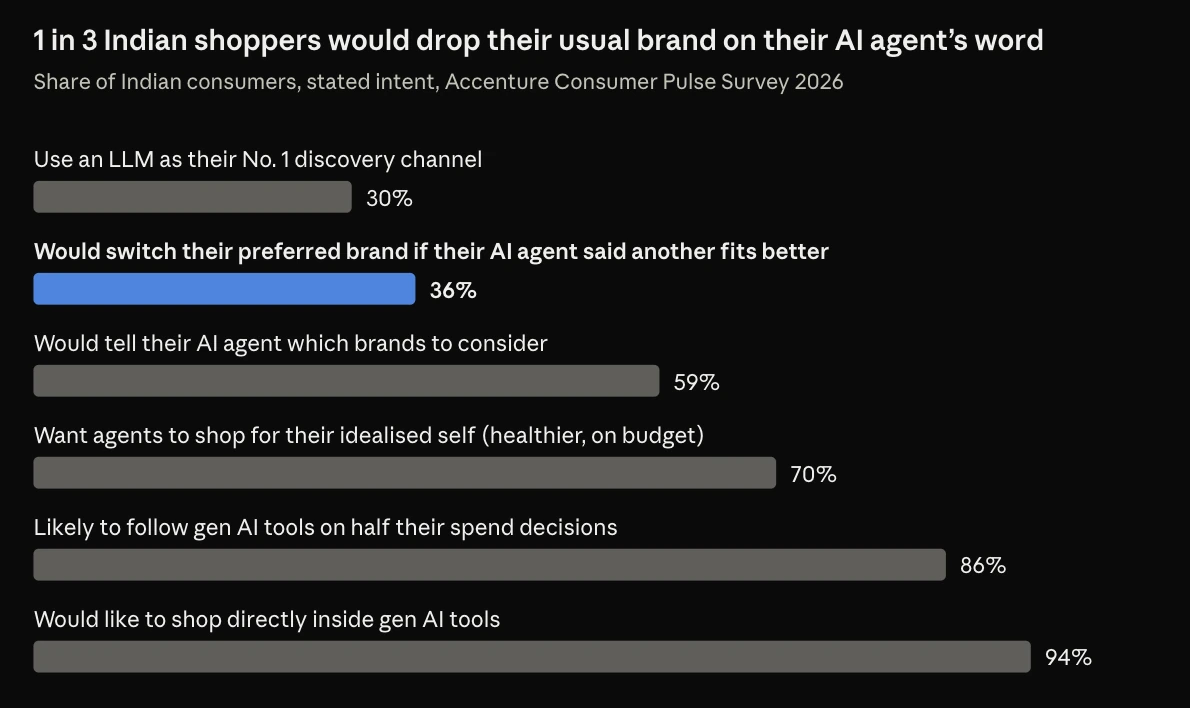
AI agents are arriving at the point of purchase. Swiggy opened Instamart to ChatGPT, Claude and Gemini in January. NPCI and Razorpay have piloted UPI payments inside ChatGPT, with BigBasket as an early merchant. Accenture's 2026 survey says nearly 30% of Indian consumers already use a language model as their first stop for discovery.
I want to look at this through a simple lens most of us learnt in a training room, not a marketing class.
The ladder of choosing
There is an old learning model called the four stages of competence. People often wrongly credit it to Maslow; Noel Burch popularised it at Gordon Training International in the 1970s. It describes how we learn a skill, from not knowing what we don't know, to doing it without thinking.
Buying is not a skill. But the ladder is a brilliant map of something that matters more to marketers: how much thinking a purchase takes. I call it the Choice Ladder.
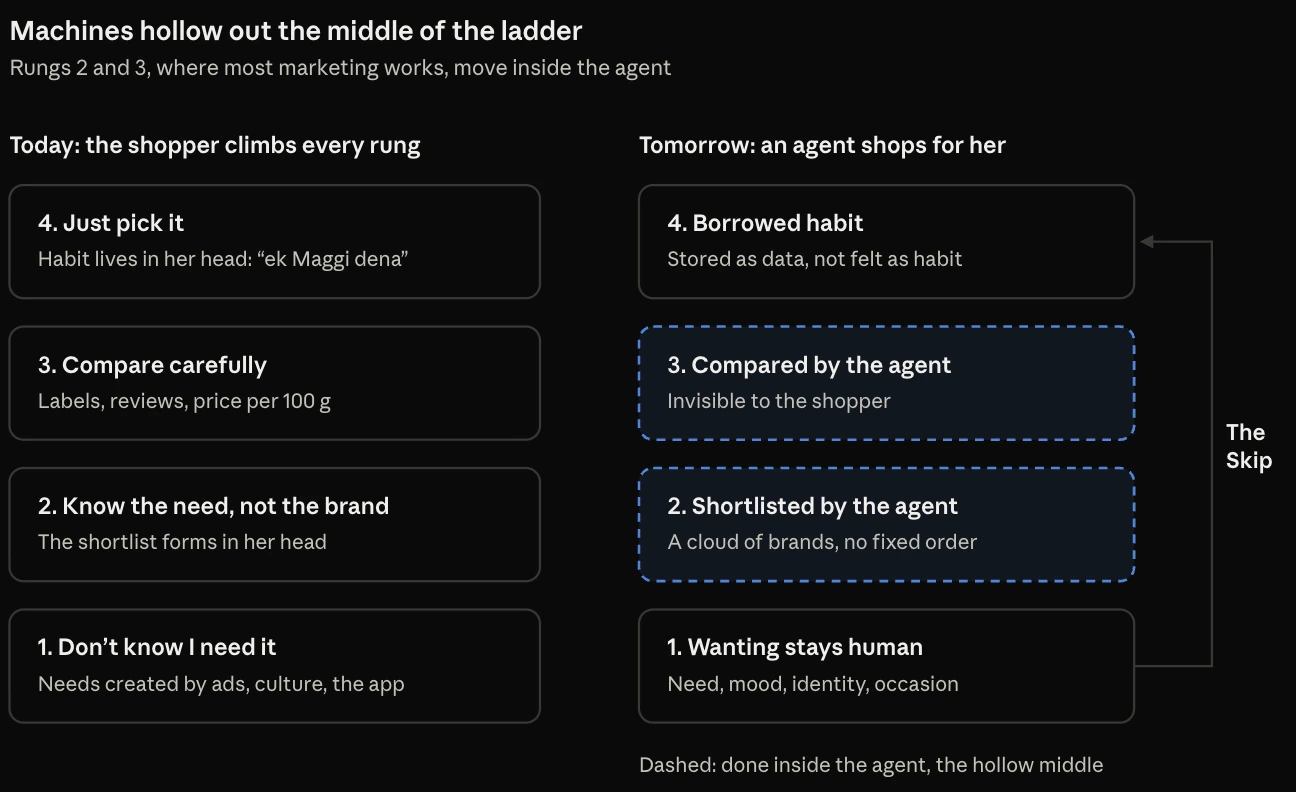
Rung 1. Unconsciously unconscious. I don't know I need it. Two years ago, most of us did not "need" packaged coconut water at 7 pm.
Rung 2. Consciously unconscious. I know I need it, but not which one. "Kaunsa sunscreen lagaun? Sab same lagte hain."
Rung 3. Consciously conscious. I am comparing. Labels, reviews, price per 100 g, my sister's WhatsApp advice.
Rung 4. Unconsciously conscious. I just pick it. "Ek Maggi dena." Some of us still say "Colgate de do" when we mean any toothpaste.
Most of the money sits on rung 4. Psychologist Wendy Wood's research finds that about 43% of our everyday actions are habits, repeated in the same context while our mind is elsewhere. Grocery replenishment is the textbook case.
Two caveats before anyone from Ehrenberg-Bass sends me a polite note. Rung 4 is rarely one brand; most of us keep a small repertoire we rotate without thinking. And people fall down the ladder. When Maggi was pulled off shelves in 2015, millions of households had to think about noodles for the first time in years. A jolt is the only moment a rival can steal a rung-4 customer.Hold on to that idea of jolts. Machines change their shape.
India is already rehearsing this
Quick commerce has quietly moved part of the ladder out of our heads and onto a screen. Redseer puts the channel at about $9 billion in the first half of 2026, doubling for the third year running, with over 60 million monthly transacting users. It also notes new consumption occasions being created on these apps: energy drinks, coconut water, dark chocolate, premium impulse snacks.
Think about what that means. The app is now doing rung 1, a job television used to do. And the "buy again" list on your Blinkit home screen is holding rung 4 for you. The habit is already half stored, not felt.
Agents simply take the next step.
What happens when a machine climbs the ladder
Here is the core asymmetry. Humans form habits because thinking is tiring. A machine is never tired. For an agent, thinking again costs a fraction of a rupee. So a machine has no natural reason to ever reach rung 4. When it repeats, it is because someone designed memory, a reorder list or an instruction into it.
That one difference produces five shifts every CMO should have on a slide.
1. The Hollow Middle. Rungs 2 and 3, the shortlist and the comparison, move inside the agent. A shopper can go from "I need something healthy for my child's tiffin" straight to "it's what we get" without ever consciously choosing a brand. I call that jump The Skip. And rungs 2 and 3 are precisely where most persuasion budgets are spent.
2. The Reroll. A chat assistant without memory re-decides every time. A SparkToro and Gumshoe study ran identical brand questions nearly 3,000 times across ChatGPT, Claude and Google's AI. The chance of getting the same list twice was under 1 in 100. Leaders who rely on being the unthinking choice lose their moat when the chooser never stops thinking.
3. The Borrowed Habit. Where agents do repeat, the habit is borrowed: copied from order history, or written into an instruction like "always Aashirvaad, 10 kg". A felt habit fades slowly. A stored habit can be overwritten in one line. Accenture found 59% of Indians would tell their agent which brands to consider. But 36% would switch if the agent suggested something better.
4. The Default Slot Moves. The unthinking choice can attach to the app or the agent instead of the brand. "Instamart pe daal do" quietly replaces "Surf Excel le aana". For category leaders, this is the biggest risk of all.
5. The Silent Shock. In controlled tests by Columbia researchers, model updates reshuffled which products agents chose. The Maggi ban made the front page. A model update shakes the machine's ladder with no headline at all.
What does not move: wanting
Machines can shop. They cannot want.
The craving, the Diwali gift, the aspiration of being a "healthier family this year": rung 1 for the human stays human. Accenture found 70% of Indians want agents to shop for their idealised self. Read that carefully. People want the machine to serve a want they already hold.
So brand building does not die. It moves to the two ends of the ladder: creating the want, and owning the stored default. The middle is where it gets hollow.
Where is your brand on two ladders?
Place every brand twice: its rung in the shopper's head, and its rung in her agent. You get four boxes.
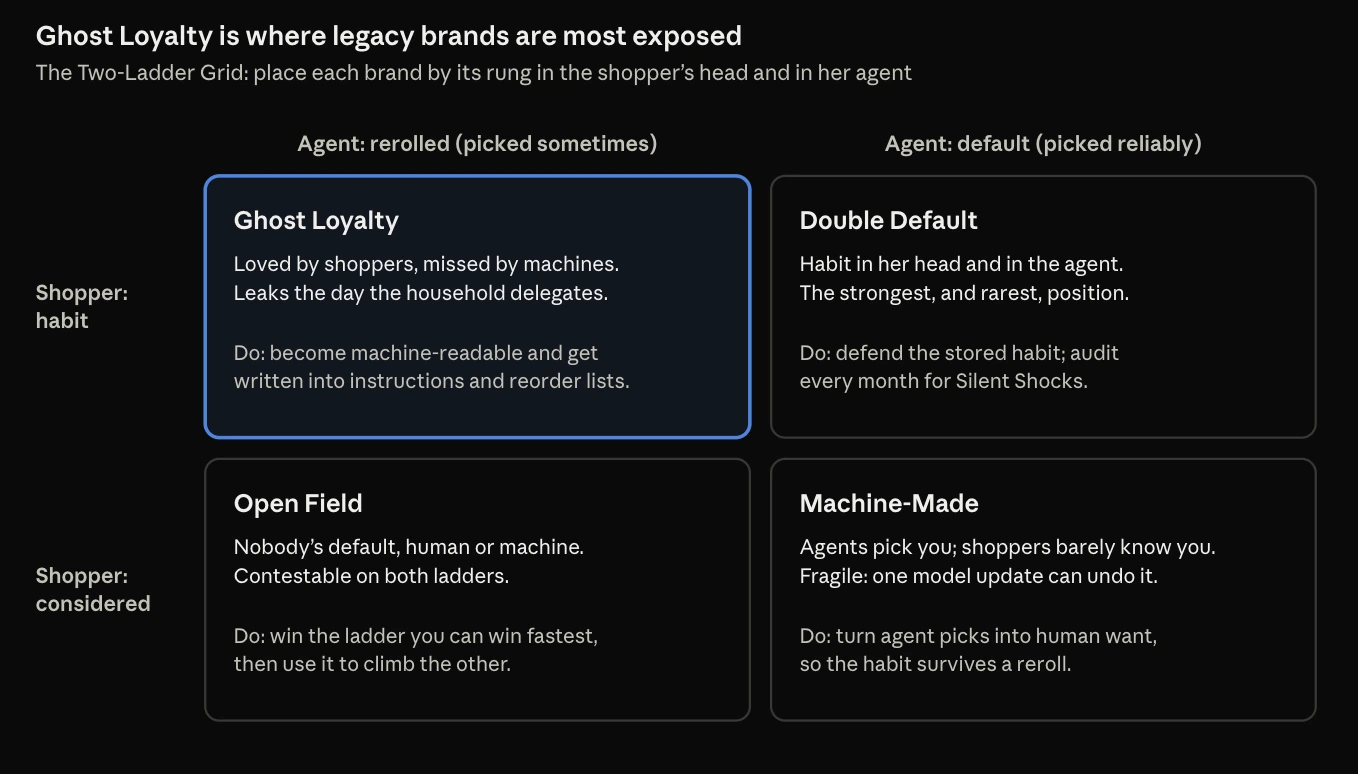
- Double Default: habit in her head and in the agent. Rare, and worth defending.
- Ghost Loyalty: loved by shoppers, missed by machines. It leaks the day the household delegates.
- Machine-Made: agents pick you, shoppers barely know you. Fragile.
- Open Field: nobody's default yet.
My hypothesis, which I want to test, not assume: many legacy Indian FMCG brands sit in Ghost Loyalty. Regional champions are especially exposed, because an EMNLP 2024 study found language models associate global brands with positive attributes and local brands with negative ones.
Five things to do before the next AOP
- Measure your rung on both ladders. Add a machine twin to every human metric you track.
- Get onto the machine's first rung. Clean product data, verifiable claims, price per unit, content in Hindi and regional languages.
- Win the agent's first pick. In a hollow-middle world, the first pick hardens into the borrowed habit.
- Fight to be written down. Reorder lists, standing instructions, replenishment pack sizes. Being remembered is no longer enough.
- Audit monthly. Treat a model update like a planogram reset at your biggest retailer.
What would prove me wrong
The strongest objection: nobody delegates a habit that already costs nothing. Fair. Picking Parle-G takes zero effort today, so the Hollow Middle will hit first where comparison is expensive (skin care, baby care, nutrition, new needs) and through basket-level requests like "the weekly list".
Adoption may also be slower than the surveys suggest. OpenAI scaled back in-chat checkout in March this year, and "would like to" in a survey is not behaviour.
That is why I am running the Ladder Test: 10 Indian categories, four prompt types (one per rung), English, Hindi and Hinglish, across the major assistants, repeated every quarter. First results soon.
Until then, one question for every brand team reading this:
On the machine's ladder, which rung is your brand on today? And how do you know?
Anil K Pandit
FROM THE AUTHOR’S ARCHIVE
First published by Anil Pandit on LinkedIn on 19 October 2026. Original wording and available illustrations are reproduced from that edition. Claims and references reflect the time of writing.
View on LinkedIn ↗What does this mean for your business?
Bring the question into a focused advisory conversation.
Work with Anil ↗