

THE ARGUMENT IN BRIEF
Anil argues that advertising measurement has concentrated on what happens after exposure while neglecting the conditions needed for a message to register. He introduces his Cognitive Signal Engine and CPCi as a proposed way to interrogate that gap.
We Have Been Measuring Advertising Backwards.
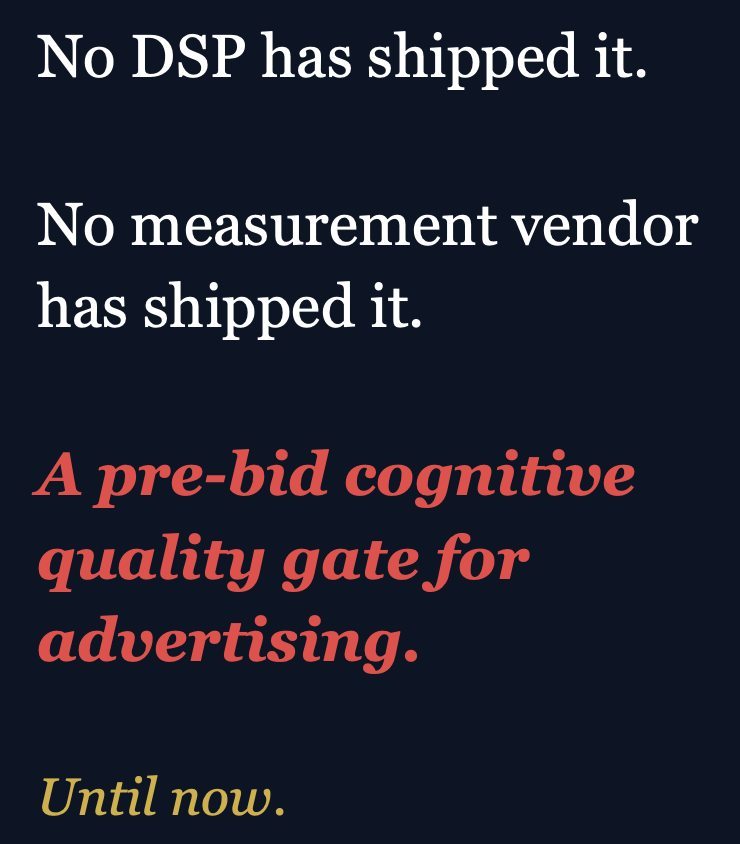
Here Is What I Built To Fix It - Introducing CPCi.
For over 24 years, I have sat inside the engine room of digital advertising. I have watched DSPs scale, retail media networks emerge, attribution models multiply, identity collapse, clean rooms appear, AI rewrite the creative production stack, and measurement get rebuilt three times over.
And in all that motion - billions of dollars of platform investment, thousands of vendor pitches, dozens of category-creation attempts - almost nobody has fixed the thing that has been broken from the start.
We have been measuring advertising backwards.
The Question We Stopped Asking
Every measurement conversation in our industry is about what happens after the ad is seen.
Did the user click?
Did they convert?
Did the campaign lift incrementally?
Did the marketing-mix model attribute properly?
Did the clean room reconcile?
Did the identity graph hold?
All of it post-exposure. All of it asking the same question, restated in seventeen different vendor decks: did the ad work?
That question is twenty years old. It has been answered, refined, automated, and largely commoditised. The platforms own it now. The DSPs own it. The clean rooms own it. The hyperscalers will own what is left of it within five years.
Meanwhile, the question nobody is asking out loud is the one that determines whether the post-exposure question even has a chance of producing a useful answer:
“Was this creative ever structurally capable of working - before we put a single dollar of media behind it?”
Sit with that question for a minute. Run it against the last campaign your team scaled. Run it against the last creative your agency presented. Run it against the next pre-bid budget you sign off on this quarter.
How I Got Here
The honest diagnosis is uncomfortable. The industry stopped asking the cognition question because the cognition question was hard, and the conversion question was easy.
Clicks were measurable. Brain processing was not. So we built an entire ecosystem around the measurable end of the funnel and quietly assumed the unmeasurable end would take care of itself.
It did not.
Roughly half of paid media spend globally - across digital, retail, programmatic, social, CTV - is poured against creative that the human brain was never structurally going to register, encode, or recall.
The platforms know.
The agencies know.
The brands know somewhere underneath the dashboard.
But none of them have a defensible way to identify which creative falls into that half before the bid is placed.
And so the industry quietly moved the goalposts. We started talking about “creative effectiveness” using post-hoc proxies - CTR, dwell time, sentiment scoring, brand lift studies. All of those are downstream symptoms.
None of them is a structural pre-bid score.
Why This Is Solvable Now — And Was Not Before
Two things changed in the last eighteen months.
First, Meta's FAIR research lab released TRIBE v2 - a deep multimodal foundation model trained on 1,117 hours of fMRI brain-imaging data from 720 subjects watching, listening to, and reading naturalistic content. TRIBE v2 predicts how 20,484 cortical brain vertices activate in response to any video, audio, or text input. It came first at the Algonauts 2025 benchmark, beating 263 competing teams. It is open research.
Second, modern computer vision and OCR became fast enough, cheap enough, and accurate enough to extract the visual features that those brain regions respond to - contrast, faces, object density, text load, colour temperature - in under two seconds, on a laptop, with no GPU and no fMRI.
In other words: neuroscience caught up enough to tell us which features of a creative drive cognitive activation, and the computer vision became cheap enough to detect those features at the speed of media trafficking.
Introducing The Cognitive Signal Engine - And CPCi
Over the last few weeks, I have built a two-layer system. I am putting it on the public record today, under the brand ADVantage Insights.
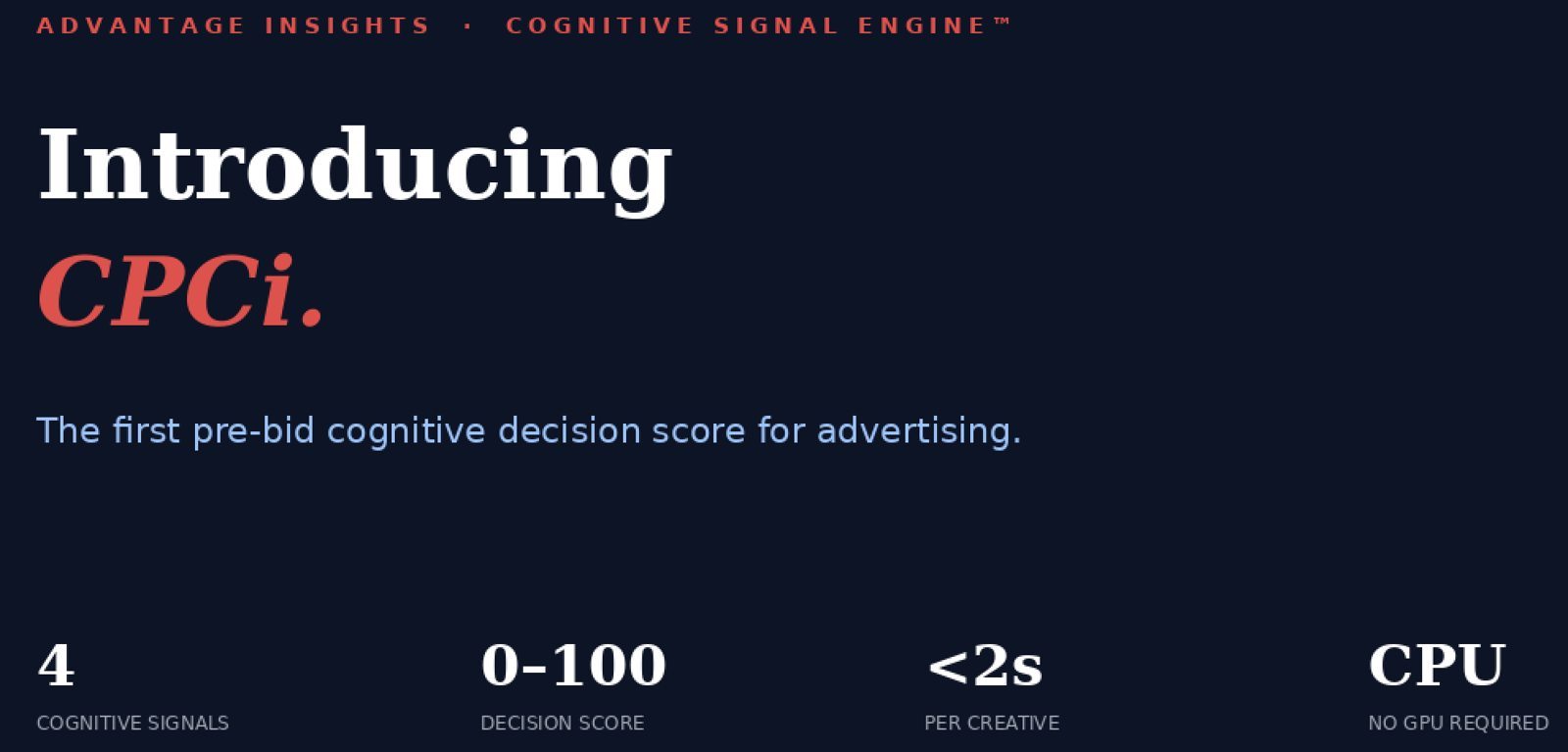
Layer one is Meta's TRIBE v2 - the open brain-encoding foundation. It is the calibration reference. It is the science. It tells us which brain regions respond to which creative features, and at what magnitudes. I do not own this layer. I do not need to. The credit belongs to the Meta FAIR team that published it.
Layer two - the layer I built - is the Cognitive Signal Engine™. It is the marketing translation layer. It takes the brain-region activation patterns from TRIBE v2's research and converts them into four signals a marketer can actually act on:
Sitting on top of those four signals is a single composite score I call CPCi - the Creative Performance Cognitive Index.
CPCi runs from 0 to 100. It is weighted differently for different media contexts. FMCG branding leans on memory. Performance marketing leans on attention. Retail media balances all four and amplifies the load penalty because the in-context environment is already noisy.
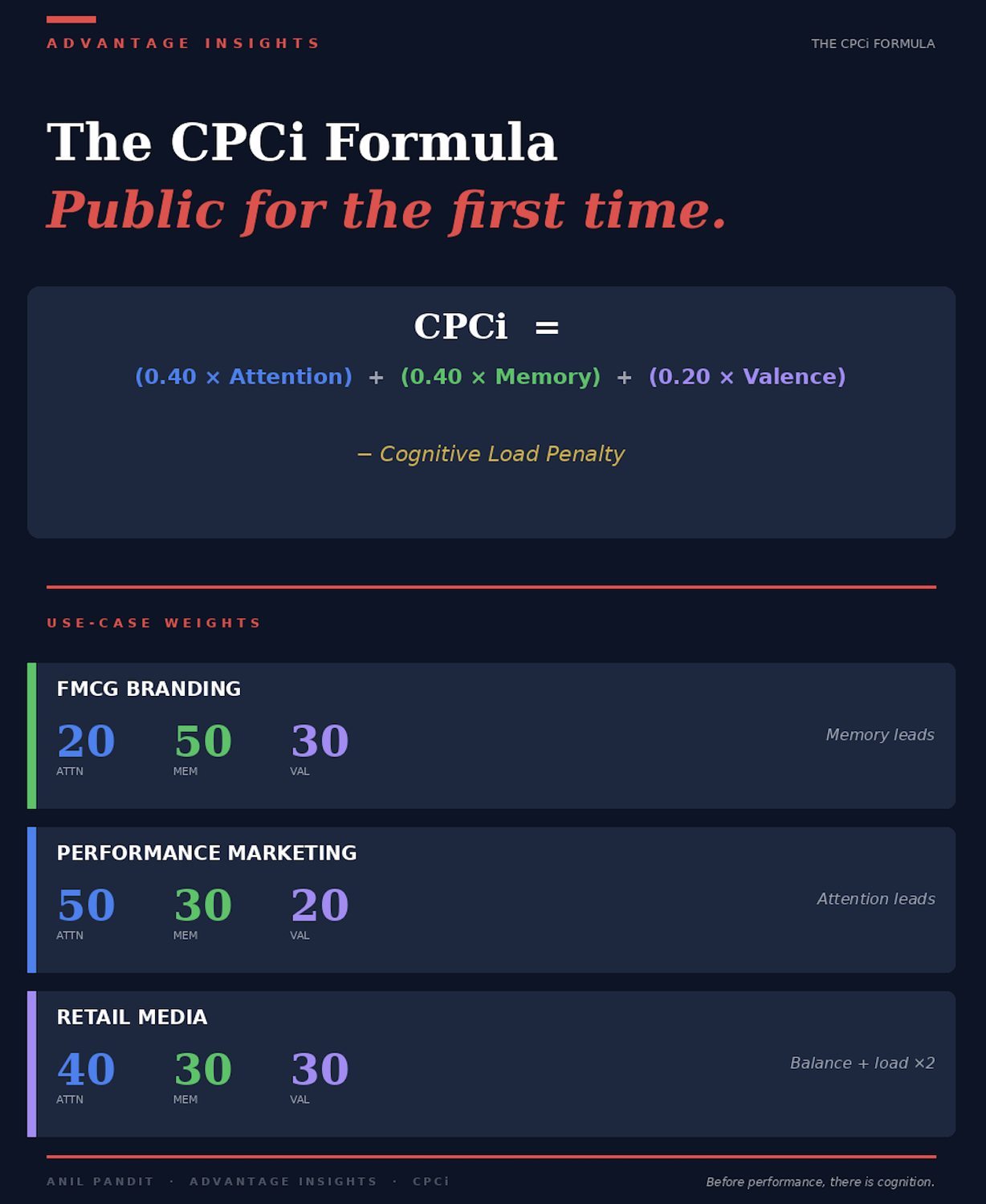
CPCi does one more thing that no other framework I have seen does.
It produces an executive verdict - three words at the top of every output. Scale. Optimise. Or kill.
TRIBE models how the brain reacts. CPCi models what marketers should do. That is the whole architectural difference.
This Is Not Neuromarketing. Here Is The Distinction.
If you have been in this industry long enough, you are already preparing the objection. We have seen this before.
Neurons.
Realeyes.
NeuroFocus.
EEG headsets.
Eye-tracking panels.
None of it scaled into pre-bid decision-making, and none of it changed the way media is bought.
That objection is fair, and I take it seriously. The reason those approaches did not change media buying is that they were always slow, expensive, panel-based, and post-production. By the time the test results came back, the campaign was already running.
They were creative-research tools. They were never decision systems for media.
CPCi is a different category. Not because I want it to be - because the architecture forces it to be:
It runs in under two seconds per creative.
It runs on a laptop CPU - no GPU, no fMRI, no panel.
It runs pre-bid - before media is purchased, not after exposure.
It outputs a single decision score and a verdict - not a 40-page diagnostic report nobody reads.
It re-tunes its weights for the specific media context it is being applied to.
What This Means For You - Three Rooms, One Question
IF YOU ARE A CMO
You have spent the last three years trying to defend marketing budgets against CFO pressure. CPCi gives you a quality gate that sits before media commitment - measurable, repeatable, and defensible in a quarterly review. It also identifies the 30–50% of your paid media that is currently flowing into creative that was never going to land. That is a number your finance team will care about.
IF YOU ARE A PERFORMANCE MARKETER
You already know which of your hooks work. CPCi tells you why - in cognitive terms, not just CTR terms. More importantly, it tells you whether a new creative is structurally likely to perform before you put cold-audience prospecting budget behind it. That alone changes how you allocate test budget across a creative library.
IF YOU ARE A RETAIL MEDIA OPERATOR
Your environment is the most cluttered surface in advertising. The cognitive load penalty matters twice as much in your context as it does in the open web. CPCi tells you which sponsored creatives will survive the noise and which will be drowned out - before you sell the placement, not after the campaign report comes in. That is a differentiator your network can productise.
What Happens Next
Over the coming weeks, I will publish:
A signal-by-signal deep dive - Attention, Memory, Emotional Valence, Cognitive Load --one per piece, with the science behind each.
A use-case breakdown for FMCG branding, performance marketing, and retail media.
A demo video showing CPCi scoring a real ad creative in under two seconds.
Five free CPCi audits for brands spending over $10M in paid media - case studies will be published anonymised.
If you want to be one of the five audited brands, comment “CPCi” below or send me a direct message.
If you want to be part of the conversation in another capacity — as an advisor, a co-creator, or simply a marketer who has been quietly thinking about this same problem — the same applies. Comment or DM, and I will be happy to evolve this further.
One Last Thing
I have been a Top Voice on this platform for a long time, and I have written a lot of posts. Most of them have been about the industry. This one is different.
Pre-bid cognitive intelligence is not a feature. It is not a tool. It is a layer that has been missing from the way media is bought, and I am not the only person in the world capable of building it - but as far as I can verify today, I am the first to at least give some shape and form to it and a name :)
That name is CPCi.
The position underneath both is simple. It will not change.
Before performance, there is cognition.
Authored By
Anil Pandit
*Disclaimer: This post is for informational purposes only and does not endorse or disapprove of any specific tools, platforms, or technologies. The views and opinions expressed in this article are those of the author and do not reflect the official policy or position of the company where he is employed.
Anil Pandit from ADVantage Insights and the inventor of the Cognitive Signal Engine™ and CPCi. He is a LinkedIn Top Voice in advertising, adtech, martech, AI, data, and measurement. ADVantage Insights is the consultancy and IP holder for the Cognitive Signal Engine framework. To request a free CPCi audit, comment on this article or message Anil directly.
© ADVantage Insights. All rights reserved. Cognitive Signal Engine™, CPCi, and Pre-Bid Cognitive Intelligence are proprietary frameworks of Anil Pandit. TRIBE v2 is open research from Meta FAIR (d'Ascoli, Rapin, Benchetrit, King et al., 2025), used as the calibration reference for the Cognitive Signal Engine. CPCi does not run TRIBE v2 inference directly; it uses TRIBE v2's published brain-encoding patterns as its scientific foundation.
FROM THE AUTHOR’S ARCHIVE
Original text from Anil Pandit’s article export. Claims and references reflect the time of writing.
View on LinkedIn ↗What does this mean for your business?
Bring the question into a focused advisory conversation.
Work with Anil ↗