

THE ARGUMENT IN BRIEF
Brand planning increasingly needs to consider both human memory and machine selection. Anil proposes the Two-Mind Funnel and Instruction Share, with practical questions for measurement, budget allocation and testing the framework’s limits.
Every rupee of brand media today is spent on one mind, the customer's. Increasingly, a second mind makes the choice. This piece is about how to plan, track and budget for both.
Which mind decides?
Let me start with a simple scene.
A working mother in Pune sees your detergent ad on YouTube six times this month. Your brand-lift study is happy. Spontaneous awareness is up, consideration is up, purchase intent is up.
On Sunday night she opens her quick-commerce app and types: "Order a good detergent for sensitive skin, delivered by 8." She doesn't name you. An assistant reads the listings, the ratings and the prices, and puts one pack in her cart.
Was it yours?
Your tracker cannot tell you. It measured her memory. But the decision was taken by a different memory: the model's.
This is the question I have been sitting with. Brands spend crores every year on reach, frequency, recall and intent, all to make sure a human remembers them at the moment of purchase. What happens when that moment is handed over to a machine? Should CMOs keep spending to influence the human mind? And how do we measure the machine's?What the evidence actually says
My first instinct was provocative: if machines buy, stop spending to make humans remember. The data does not fully support that. It also does not support business as usual.
Five findings that cut against the provocation:
- Fame still reaches the machine. A WARC study of 30 brands across six categories, tracked over eight months, found that about two-thirds of LLM visibility comes from brand building done over time (June 2026).
- A second study landed in the same place. News Corp Australia looked at 148,000 pages cited across 10,000 AI answers and put 63% of visibility down to existing brand equity (July 2026).
- But it is fame, not spend. In Ahrefs' study of 75,000 brands, branded web mentions correlated 0.664 with AI Overview visibility. Paid search ad cost correlated just 0.215.
- Most people are not delegating yet. In Gartner's US surveys (late 2025 to January 2026), only 11% were willing to let AI make the purchase decision, even for household supplies.
- Humans still name brands. In BrightEdge's auto-category analysis, 30% of ChatGPT's purchase-intent prompts carried a brand name.
Three findings that support it:
- The machine increasingly picks for us. In that same BrightEdge data, 70% of ChatGPT's purchase-intent prompts named no brand, and 97% of unbranded answers still recommended one.
- The machine's shortlist is short. Captify UK found about 70% of AI answers push a single primary brand (July 2026). A human considers three or four brands. The machine often offers one.
- Machine loyalty is brittle. Xi Chu and Yupeng Hou tested GPT-4o-mini, Claude Sonnet and Gemini 3 Flash. Famous brands won 100% of recommendations when specs were identical, but lost that edge to a rival with less than a 0.1-star rating advantage (June 2026). A human forgives a small gap for a brand she trusts. The machine does not.
So the honest answer is neither "stop" nor "carry on". Human brand building now has two jobs, and we measure only one of them.
The Two-Mind Funnel
Here is the idea in one picture. Every brand now sits in two funnels at once: the shopper's and the machine's. They are joined in two places.
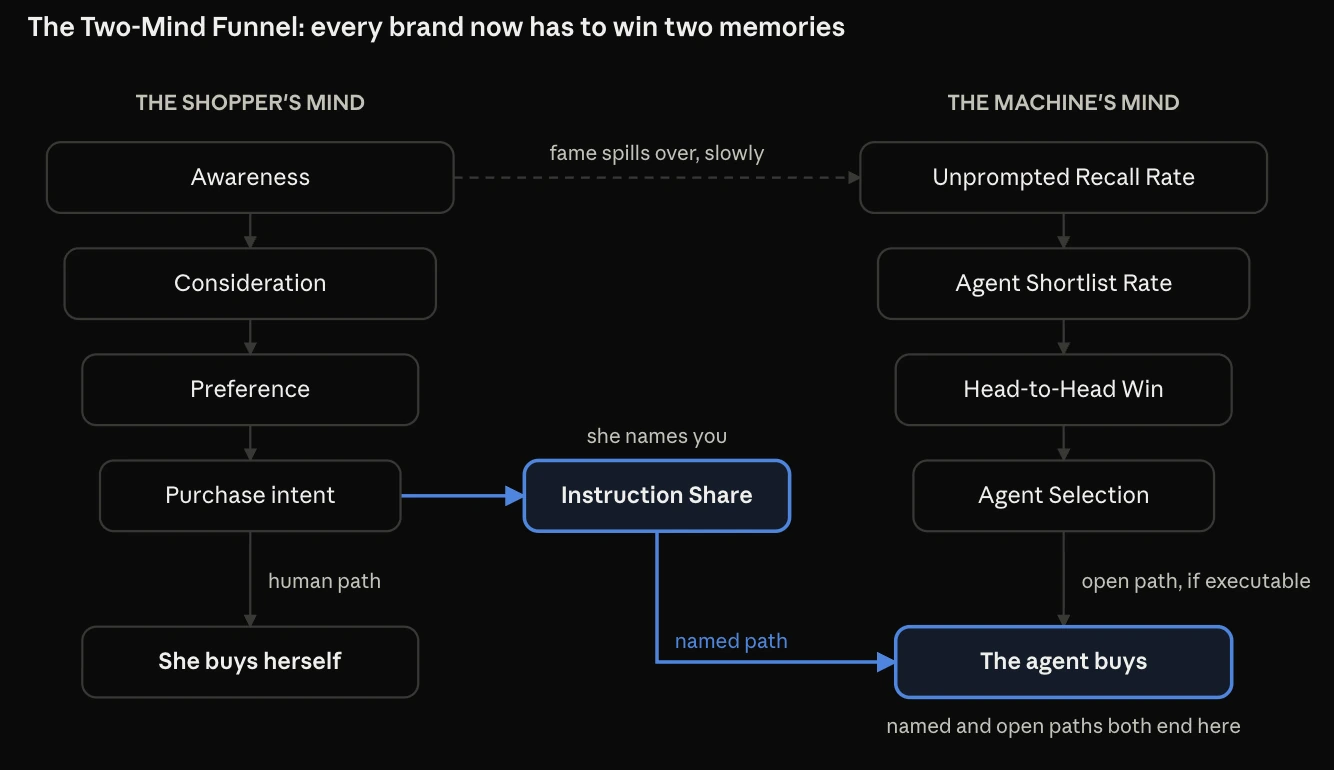
- The bridge, Instruction Share: when the shopper names you, her memory goes straight into the agent's instruction. Your human brand building pays off directly.
- The spillover: what people say and write about famous brands becomes what the machine reads. That link is real, but slow.
Every brand metric needs a machine twin
The good news: we don't need to throw away the brand-health tracker. We need to give each metric a twin that measures the machine's mind
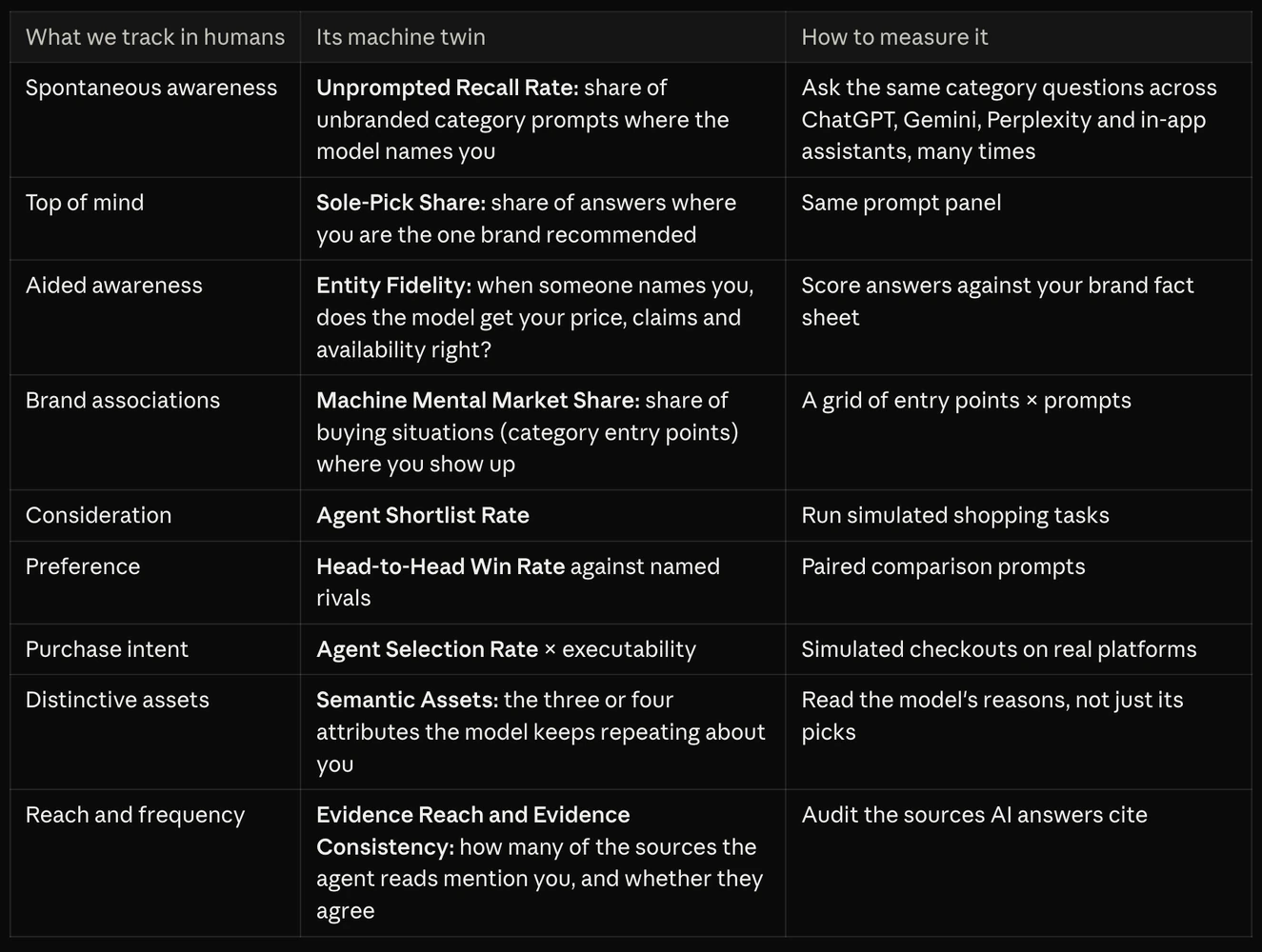
That last row matters most. A human remembers you because she saw you often. A machine recommends you because it read about you often, in places it trusts, saying the same thing.
The metric that joins the two minds: Instruction Share
Instruction Share is the share of delegated purchase instructions that name your brand.
"Reorder my Surf Excel." "Get Maggi, two packs." "The usual Amul butter." Each of these is a human memory turned into a machine command. When a shopper names you, the agent mostly just executes. Your ad did its job, and the machine never had to choose.
When she doesn't name you, the agent chooses for her. That choice comes from the machine's mind, not hers.
This is why Instruction Share is the metric I would put on every CMO's dashboard. It tells you how much of your human brand building is still converting into sales once buying is delegated. It is also the cleanest way to answer the CFO who asks, "If agents are buying, why are we still on YouTube?"
How to measure it today:
- Platform data: ask your quick-commerce and e-commerce partners for the share of assistant or reorder sessions that name your brand. Few share this yet, so negotiate for it in your retail media deals.
- Panels: run a diary or survey panel asking people exactly what they typed or said to the assistant.
- Lift tests: exposed-versus-control studies already exist that check whether ads drive branded prompts in LLMs. DISQO's AI Search Lift is one example.
Three paths to a sale
Once some buying is delegated, every sale reaches your brand by one of three paths:
- The human path. She shops herself. Classic mental and physical availability decide.
- The named path. She delegates, but names you. Instruction Share decides.
- The open path. She delegates and names nobody. The machine's mind decides.
Put together, it is one line of maths:
\text{Brand share} = (1 - D)\,H \; + \; D\,\big[\,N \cdot IS + (1 - N) \cdot MS\,\big]\,E- D: share of category purchases delegated to an agent
- H: your brand's share among human shoppers
- N: share of delegated purchases where the shopper names a brand
- IS: your Instruction Share
- MS: your machine selection share on open occasions
- E: executability, i.e. can the agent actually buy you (in stock, listed, checkout-ready)
A worked example makes the stakes clear.
Take a brand with 25% share among human shoppers. Now let 20% of the category's buying be delegated. Suppose 40% of those shoppers name a brand, your Instruction Share is 30%, the machine picks you 12% of the time on open occasions, and you are executable 80% of the time.
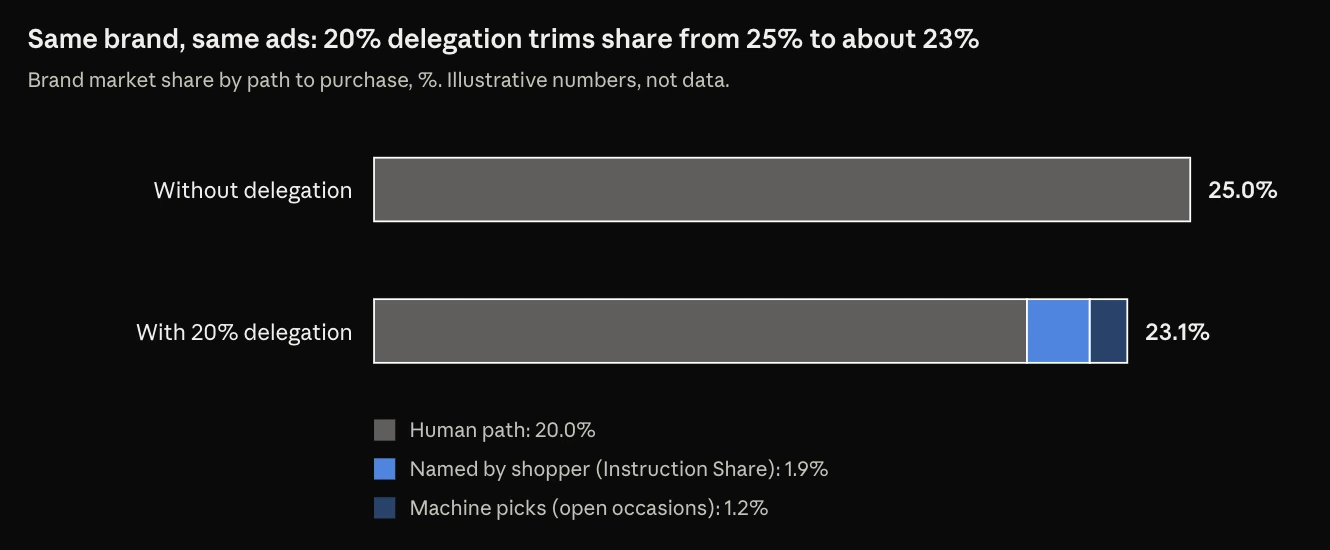
Nothing about your advertising changed. Your share dropped by almost two points because the machine's mind ranks you lower than the human mind does, and the agent can't always buy you. Spread across a full category, that is real money.
How to split the budget
I'd stop thinking of the media plan as one pot aimed at one audience. Think of it as four buckets.
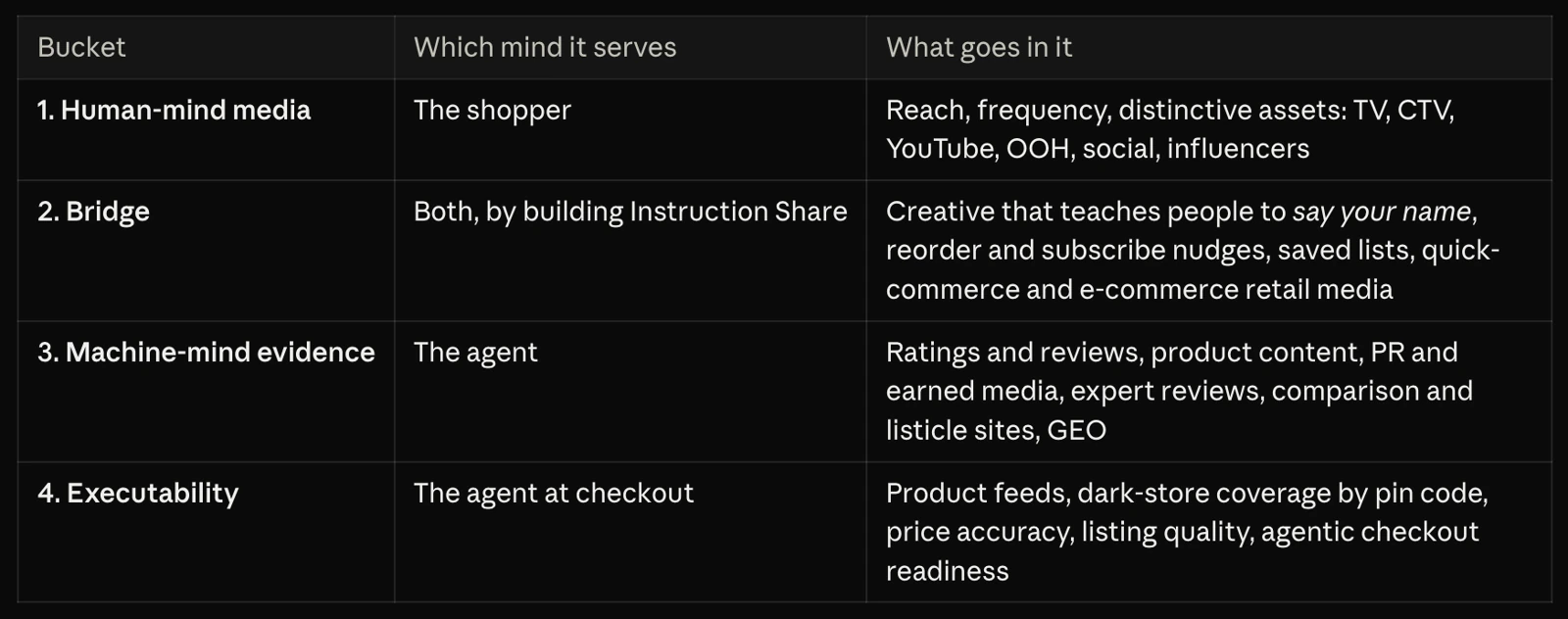
The floor rule.
Buckets 3 and 4 together should get at least D × (1 − N) of the budget: the share of category buying that is delegated and unnamed. In our example that is 20% × 60% = 12%. Human media earns some credit against this floor, because fame spills over into the machine's memory. But the spillover is slow and uneven, so I'd not count on it for more than half.
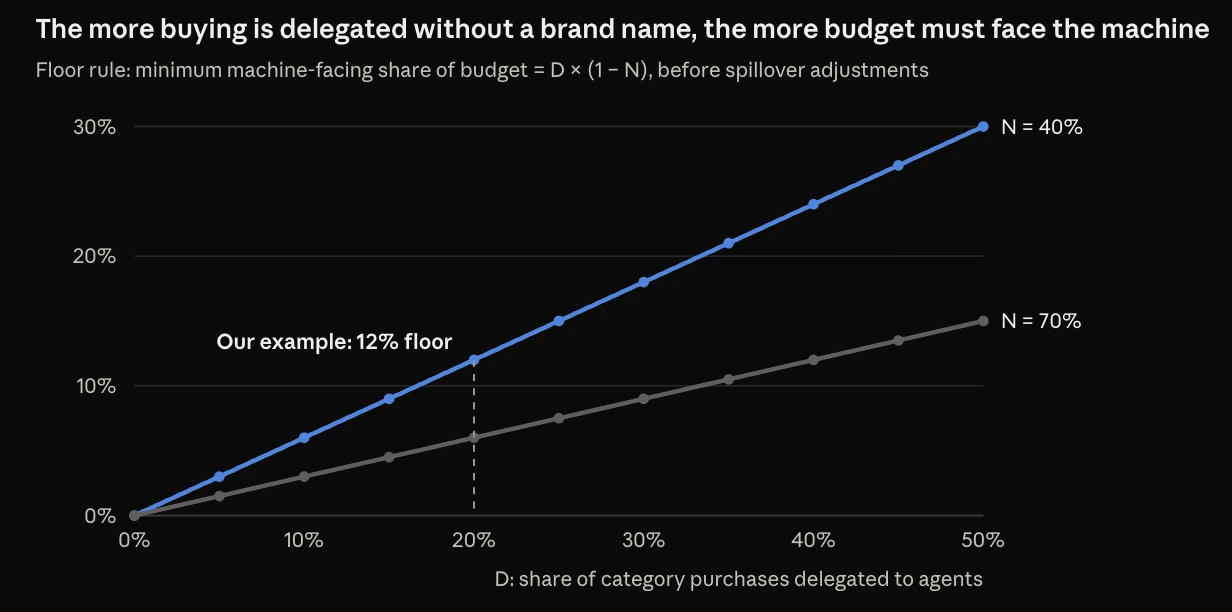
The tilt depends on your objective, not just your category:
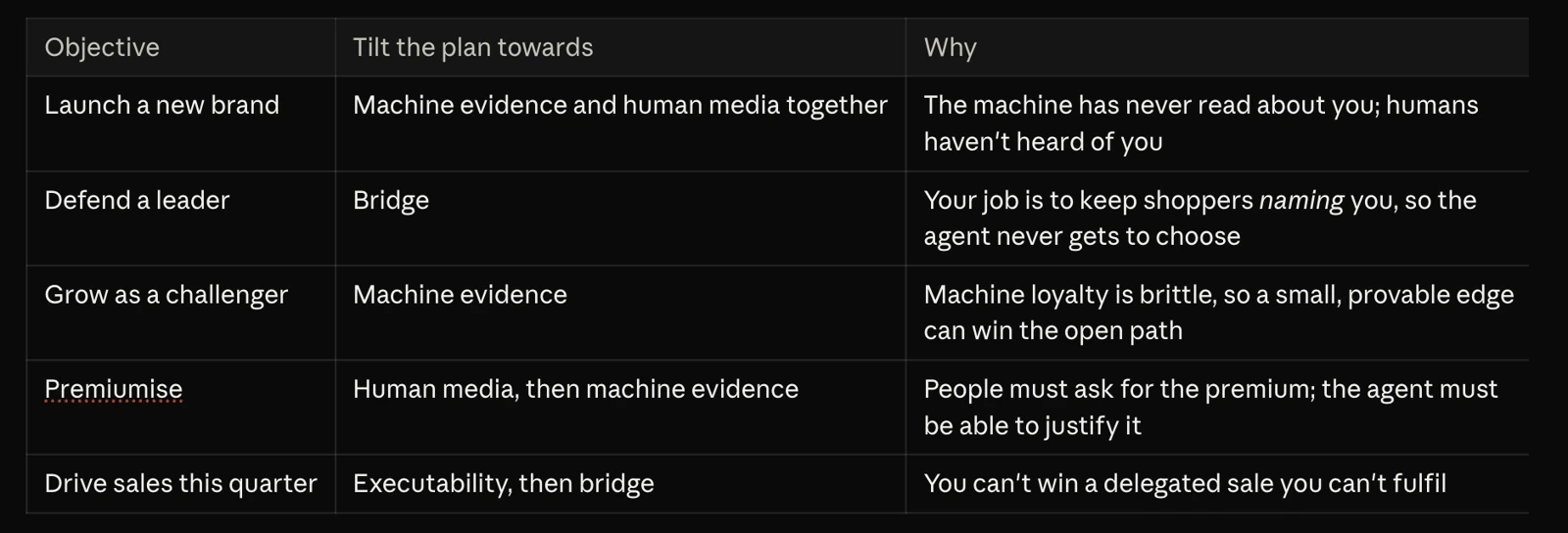
Category matters too.
In Indian FMCG, habit categories like atta, oil, tea and detergent will see more named reorders, so the bridge carries more weight. Exploration categories like snacks, skincare or a new beverage will see more open prompts, so the machine's mind matters more. Quick commerce adds a twist: executability is decided dark store by dark store.
The machine's mind runs on two clocks
Human memory fades and refreshes campaign by campaign. The machine's memory works differently, and planners need to know this.
- The fast clock: what the agent reads today. Most assistants now search the live web, retailer listings and reviews before they answer. A good PR story, a rating jump or a fixed product page can change answers within days or weeks.
- The slow clock: what the model learnt in training. The model's built-in sense of which brands matter in a category changes only when a new version is trained and released. Months, not weeks.
This is my reading of how these systems work, not a published finding, so test it on your own brand. But the planning implication is clear. Burst campaigns can move the fast clock. Only years of consistent fame move the slow one. That also explains why the WARC and News Corp numbers point to long-term brand equity.
Where I could be wrong
I'd rather say this upfront than read it in the comments.
- D and N are hard to see. Platforms hold the instruction logs. Until they share them, brands must estimate from panels and surveys.
- Machine answers are noisy. The same prompt gives different answers on different days and model versions. Any machine tracker needs large, repeated samples and must record the model version.
- Spillover may not be causal. Famous brands also have more reviews and more coverage. The fame-to-machine link in the studies above is an association. A proper test is a machine brand-lift study: probe the models before and after a campaign, against a control market.
- Ads inside assistants could change everything. If agent shelves become paid placements, part of the machine's mind becomes a media buy again, and retail media teams will own it.
What to do on Monday morning
- Add a machine twin to your brand tracker. Start with three: Unprompted Recall Rate, Sole-Pick Share and Entity Fidelity. Track them monthly, by model.
- Ask your platform partners for Instruction Share. Put it in your next quick-commerce or e-commerce retail media negotiation.
- Estimate your D and N. Even a rough guess tells you your floor for machine-facing spend.
- Brief creative to build Instruction Share. The brand that people say out loud to their assistant wins the named path.
- Treat ratings, product data and dark-store availability as media. They are what the machine reads.
If you read my earlier piece on Delegated Availability, this is its other half. That one dealt with the physical side: can the agent find and buy you? This one deals with the mental side: will the agent, or the shopper instructing it, choose you?
To make this practical, I have built the Two-Mind Funnel Calculator in two versions:
- One for Indian FMCG and quick commerce, one for any category.
- Enter your category, objective, brand position and a few numbers. It shows where your sales come from, which mind you are losing, and how to split your budget across the four buckets.
- Try both calculators at twomindfunnel.netlify.app: free, no login, nothing you type is stored
- India Two-Mind Calculator: FMCG and quick commerce, with channel mix across quick commerce, e-commerce, modern trade and kirana
- Two-Mind Calculator: any category, from FMCG to travel, auto and B2B
The brands that win the next five years will not be the ones that pick between the human mind and the machine. They will be the ones that budget for both and measure both.
Anil K Pandit | ADVantage Insights
FROM THE AUTHOR’S ARCHIVE
First published by Anil Pandit on LinkedIn on 15 October 2026. Original wording and available illustrations are reproduced from that edition. Claims and references reflect the time of writing.
View on LinkedIn ↗What does this mean for your business?
Bring the question into a focused advisory conversation.
Work with Anil ↗