

THE ARGUMENT IN BRIEF
Attention measurement can establish whether an ad was seen, yet the business question extends to what registered and influenced a decision. Anil examines the case for cognitive measurement and its limits.
The "Attention Mirage" is fading, but what emerges from the mist isn't just a better version of eye-tracking. We are witnessing a fundamental shift from measuring exposure to quantifying influence.
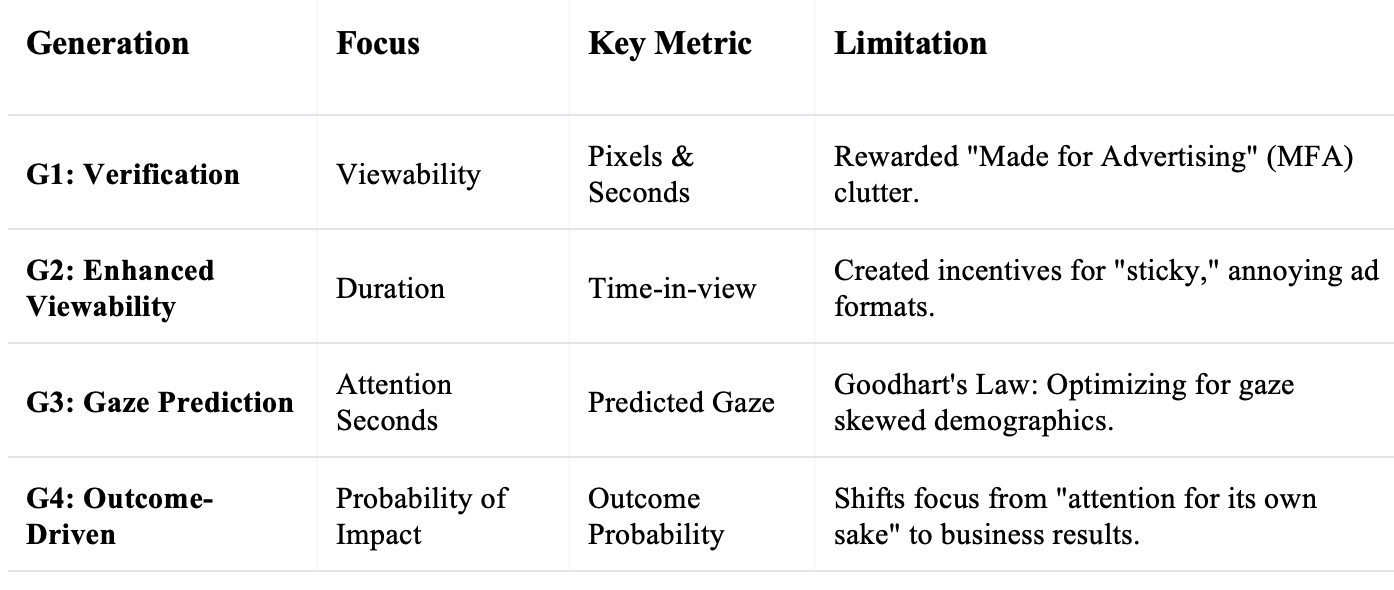
The Four Generations of Measurement
As Marc Guldimann of Adelaide points out, we have evolved through four distinct stages of media quality assessment :
The Attention Mirage: Why Your Ad Spend is Built on Sand
Most marketers are chasing a ghost: "Attention Metrics." They believe these numbers are the holy grail, the definitive proof of ad effectiveness. But what if I told you that this obsession is leading us down a dangerous path, costing brands millions, and obscuring the true drivers of impact?
For years, we've been told that viewability was the problem. Then came attention metrics – the promise of knowing if someone actually looked at your ad. Sounds great, right? Yet, a growing body of evidence suggests we're still optimising for the wrong thing, mistaking fleeting glances for genuine engagement.

The Three Cracks in the Foundation of "Attention"
The Illusion of Engagement: Ad Slot vs. Creative.
A critical flaw in current attention measurement is its focus on the ad slot, not the creative itself. Imagine measuring the effectiveness of a billboard by how many cars drive past it, rather than the impact of the message on the billboard. Many platforms tell you if an ad could be seen, or if the placement garnered attention, but not if your message resonated. This leads to a dangerous disconnect: high attention scores for poor creative, and wasted budgets.
2. The Prediction Problem: Metrics or Models?
Many of the much-touted "attention metrics" aren't actually measuring campaign performance post-launch. Instead, they are predictive algorithms designed to estimate the attention an ad slot will get. While useful for planning, this isn't a measurement. It's a forecast. Relying solely on these predictions without actual, post-campaign creative effectiveness measurement is like judging a chef by the quality of their ingredients, not the taste of the meal.
3. The Standardisation Trap: One Size Fits None.
There's a significant lack of industry-wide standardisation for attention metrics . Different vendors use different methodologies, making it nearly impossible to compare apples to apples. This fragmentation creates confusion and hinders true optimisation. Furthermore, a blanket approach to attention risks oversimplifying a complex human behaviour. As one expert noted, "attention isn't all you need" ; it can create a misleading equivalence between seeing and processing.
The Cost of the Mirage: Millions Wasted, Opportunities Lost
Research from Lumen indicates that only 30% of viewable digital ads are actually looked at. This means a staggering 70% of ad spend on viewable impressions captures no real attention. This isn't just a theoretical problem; it's a multi-million dollar leak in marketing budgets globally. Over-reliance on these flawed metrics can artificially limit ad supply and drive up costs without delivering genuine impact.
Storytelling Example: I recently spoke with a CMO who, after investing heavily in a campaign that boasted top-tier attention scores, saw no discernible lift in brand recall or sales. Their agency celebrated the "attention," but the business impact was flat. The disconnect was clear: they had measured exposure, not influence.
Beyond the Gaze: Measuring What Truly Matters
It's time to move beyond the superficial gaze and measure what truly drives business outcomes. We need to shift our focus from passive attention to active engagement and cognitive resonance.
For CMOs and Brand Leaders: Demand metrics that link directly to brand perception, recall, and ultimately, sales. Challenge your agencies to prove not just that an ad was seen, but that it was processed and remembered.
For AdTech Innovators: The future lies in developing solutions that measure the quality of attention, the impact of creative, and the contextual relevance of placement. We need tools that can differentiate between a fleeting glance and genuine mental processing.

The AI Revolution: From Gaze to Cognition
In the AI era, attention metrics are evolving into Cognitive Measurement. We are no longer just asking "did they look?" but "what happened in their brain when they did?"
1. Real-Time Emotional Mapping
AI-driven creative testing is moving from panels to real-time algorithmic prediction. Tools are now integrating cognitive-neural data—attention level, mental load, and emotional responses—with machine learning to predict how a creative will perform before a single dollar is spent.
2. The "Cognitive Resonance" Metric
The future replacement for the attention second is Cognitive Resonance. This isn't measured by a stopwatch, but by the delta in brand perception post-exposure. AI models now analyze "digital cognition" - using behavioural data to predict how exposure influences a user's memory and future purchase intent .
3. Generative AI as a Measurement Tool
Generative AI isn't just for creating ads; it's for simulating audiences. We are seeing the rise of "Synthetic Respondents"—AI models trained on vast datasets of human behaviour that can predict with 90%+ accuracy how a specific demographic will react to a creative concept, effectively "measuring" the ad before it even exists .

The Hybrid Future: Attention + Outcome
The consensus is moving toward a Hybrid Model. Attention won't disappear; it will be demoted from a "Primary KPI" to a "Critical Input."
•Attention as the Gateway: It confirms the opportunity for impact.
•Cognitive Data as the Process: It measures the depth of the mental processing.
•Outcome as the Currency: It provides the proof of business value (Recall, Intent, Sales).
The measurement of the future is a "Probability of Outcome" score, powered by AI that understands the intersection of media quality, creative resonance, and individual user context.
The question isn't if attention metrics are going away, but when. The brands and adtech players who recognise this shift now will be the ones to dominate the next era of advertising effectiveness.
In the AI era, attention metrics are evolving into Cognitive Measurement. We are no longer just asking "did they look?" but "what happened in their brain when they did?"Questions for the Community:
Anil Pandit
*Disclaimer: This post is for informational purposes only and does not endorse or disapprove of any specific tools, platforms, or technologies. The views and opinions expressed in this article are those of the author and do not reflect the official policy or position of the company where he is employed.
FROM THE AUTHOR’S ARCHIVE
Original text from Anil Pandit’s article export. Claims and references reflect the time of writing.
View on LinkedIn ↗What does this mean for your business?
Bring the question into a focused advisory conversation.
Work with Anil ↗