

THE ARGUMENT IN BRIEF
As generative AI reduces some production effort, agency pricing and client expectations may change. Anil explores how agencies can demonstrate value when efficiency gains put existing fee models under pressure.
Generative AI (GenAI) has become a transformative force across industries. Its ability to supercharge efficiency and creativity is undeniable, but as the IT services sector grapples with intensifying pricing pressures caused by GenAI-driven efficiencies, the advertising industry must take note.
The IT sector's story is not just a cautionary tale—it’s a glimpse into a reality we might soon face. As clients demand that productivity gains be passed down, the balance between efficiency and margins is becoming precarious. For advertising agencies, this shift raises critical questions:
How can we leverage GenAI to unlock value while protecting profitability?
Which parts of our operations are most susceptible to pricing pressures?
What frameworks or strategies can help navigate this paradox effectively?
Lessons from the IT Industry’s GenAI Pricing Pressures
I recently came across an article highlighting how IT companies are experiencing a double-edged sword with GenAI (Link below):
Efficiencies Creating Pricing Pressure GenAI tools (like Copilot) are boosting productivity, and reducing the need for extensive human resources. Clients are leveraging these efficiencies to demand lower prices or more output at the same cost.
Margin Compression Despite Premium Pricing While GenAI talent commands a higher hourly rate, the overall deal sizes are shrinking due to reduced project scopes.
Shifting Client Expectations Renewals often come with demands for increased scope at the same price or reduced deal values for the same work. Providers are pivoting strategies to grow volumes or deepen client relationships instead of relying on higher pricing.
Drawing Parallels with the Advertising Industry
This article made me think that the advertising world is no stranger to disruption, but GenAI brings a unique challenge that could fundamentally alter our business models.
Efficiency vs. Creativity GenAI has revolutionized content creation, media planning, and campaign optimization. Ad copy that once took days can now be generated in seconds. Clients, however, may see this as a reason to expect faster turnarounds and lower costs, even for creative work that still requires human finesse.
Eroding Margins on Retainers Just as IT clients push for productivity gains to translate into cost savings, advertisers could face pressure on retainers. “Can you manage our campaigns with 30% fewer resources since GenAI is doing the heavy lifting?” This question may soon become a norm.
The Threat to Premium Pricing While expertise in using GenAI tools might command a premium initially, the broader narrative could shift to overall cost efficiency rather than value addition. Clients might demand unified reports or AI-enhanced insights without factoring in the investment required to build these capabilities.
Renewal Dynamics Like IT contracts, media buying and campaign management agreements might increasingly come with demands for “more for less”—expanded scopes or performance guarantees at the same budget levels.
A Framework to Navigate GenAI-Driven Pricing Pressures
To address these challenges, advertising agencies can adopt the E.V.A.L. Framework—a structured approach to balance efficiency, value, adaptability, and longevity:
E – Enhance Creative and Strategic Differentiation: Use GenAI for efficiency but double down on creative and strategic services that remain uniquely human. Example: Position your agency as a thought partner, offering insights into consumer psychology, market trends, and storytelling that GenAI cannot replicate.
V – Value-Based Pricing Models: Shift from resource-based pricing (hours or team size) to value-based models that emphasize outcomes. Example: Tie pricing to metrics like brand lift, engagement rates, or return on ad spend (ROAS), making the agency indispensable to the client’s success.
A – Adapt Operations and Upskill Teams: Redesign workflows to integrate GenAI while maintaining quality and creativity. Invest in training teams to become GenAI-augmented strategists, emphasizing tools that enhance their expertise.
L – Leverage Data Clean Rooms and Transparency: Build trust by using GenAI responsibly and transparently. Example: Integrate data clean rooms to ensure privacy compliance while offering enhanced insights.
A Grid Framework for Functional Responses
Here’s how different functions within advertising agencies can respond to pricing pressures:
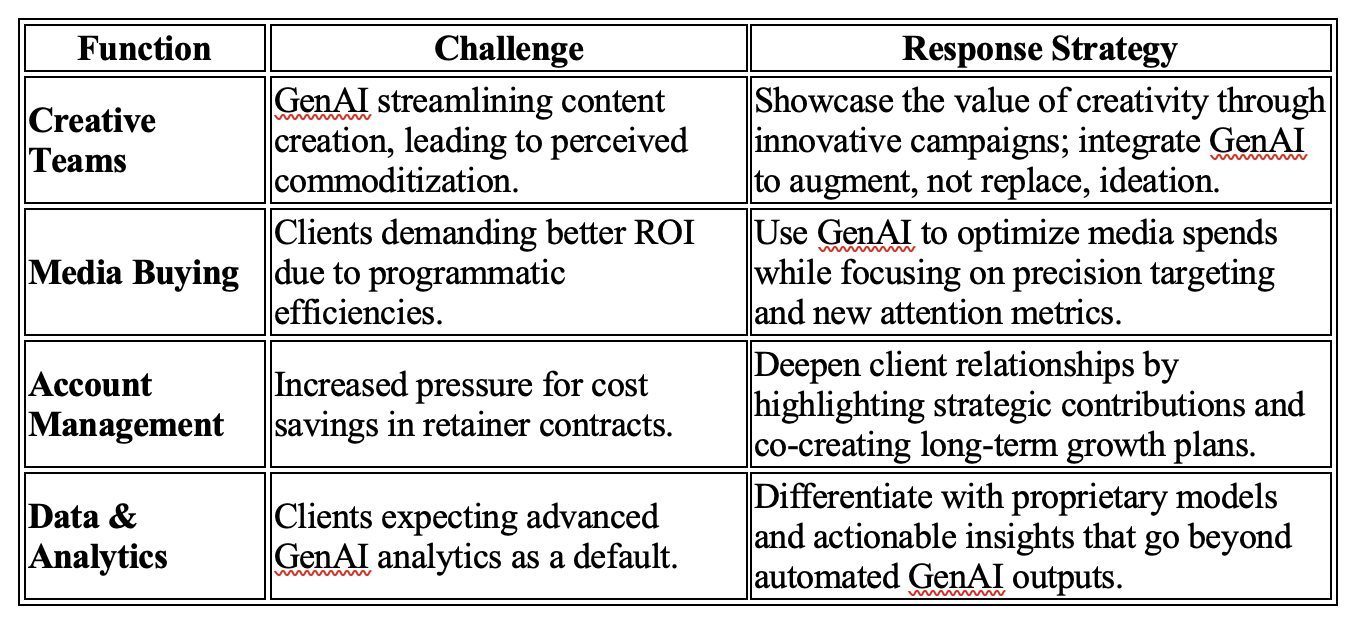
What Advertising Agencies Must Do Now
Proactively Address Client Expectations: Initiate conversations about the true cost of GenAI capabilities and the value they deliver.
Reinvest in Differentiation: Build proprietary tools and methodologies that extend beyond GenAI’s generic capabilities.
Prepare for Contractual Evolution: Develop flexible contract structures that accommodate GenAI efficiencies without eroding margins.
Educate Clients on Long-Term Impact: Showcase how GenAI augments creativity and strategy, ensuring clients see the technology as an enabler rather than a cost-cutting tool.
Other frameworks that might help or a combination of these should be looked into based on one’s current situation, strengths, capabilities, and team expertise.
1. The 3Ps Framework: Productivity, Positioning, and Partnerships
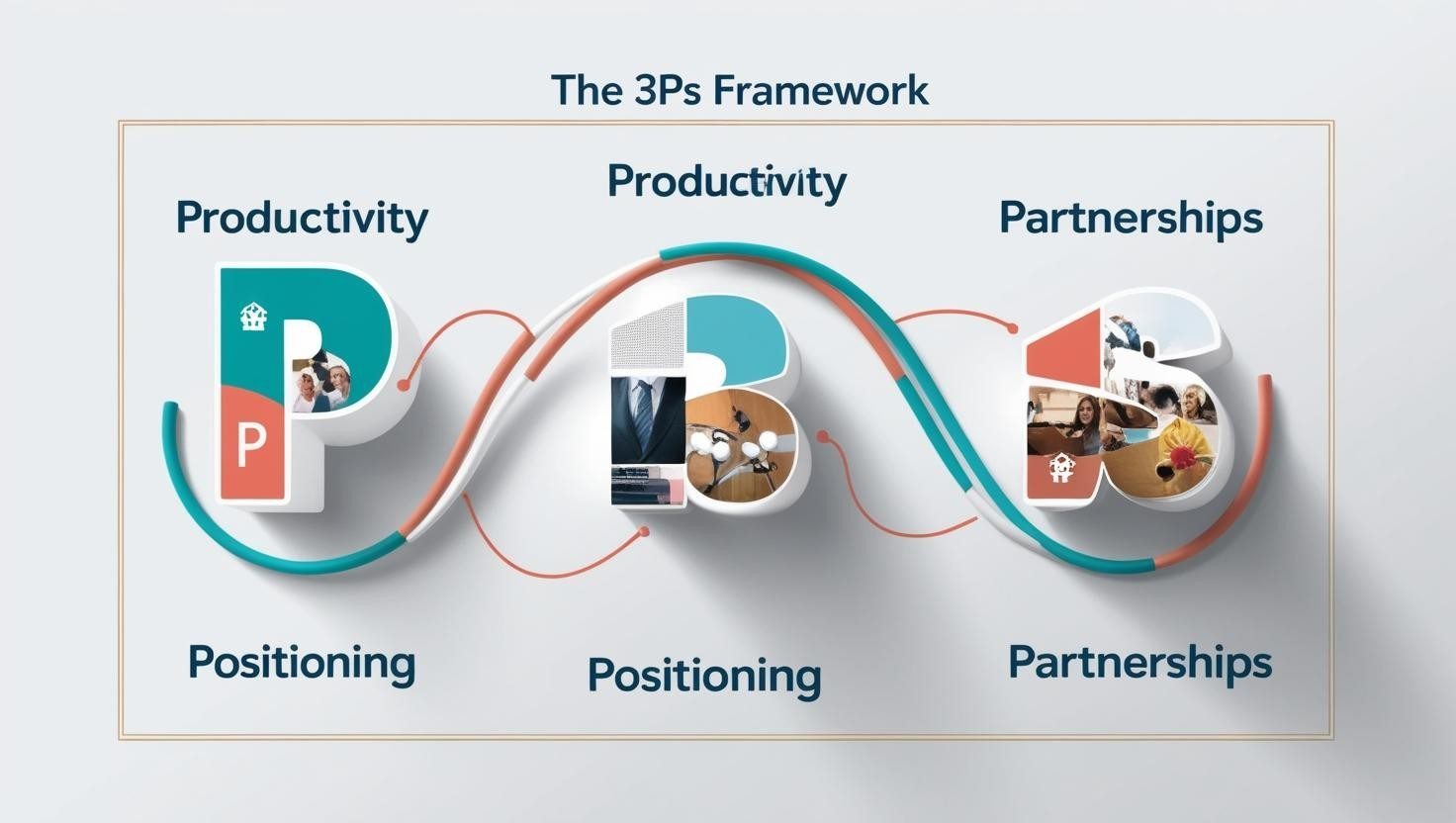
This framework focuses on leveraging internal efficiencies, redefining agency value, and strengthening client relationships.
Productivity
Challenge: GenAI’s efficiencies can commoditize agency services.
Response: Implement productivity-focused initiatives where GenAI automates repetitive tasks, allowing teams to focus on high-value areas like strategy and ideation. Track and showcase how these efficiencies improve campaign performance, not just cost reduction.
Positioning
Challenge: Clients view GenAI output as interchangeable across agencies.
Response: Rebrand your agency as an innovation partner, offering bespoke GenAI-enabled solutions that focus on unique outcomes, like cultural relevance or emotional resonance. Develop GenAI-powered proprietary tools to differentiate your offering.
Partnerships
Challenge: Clients demand cost efficiencies that threaten margins.
Response: Build closer partnerships with clients to create shared value, such as co-investing in GenAI tools or joint development of data insights. Introduce GenAI workshops to educate clients, positioning the agency as a trusted technology advisor.
2. The T.I.E.R. Framework: Technology, Innovation, Experience, Results
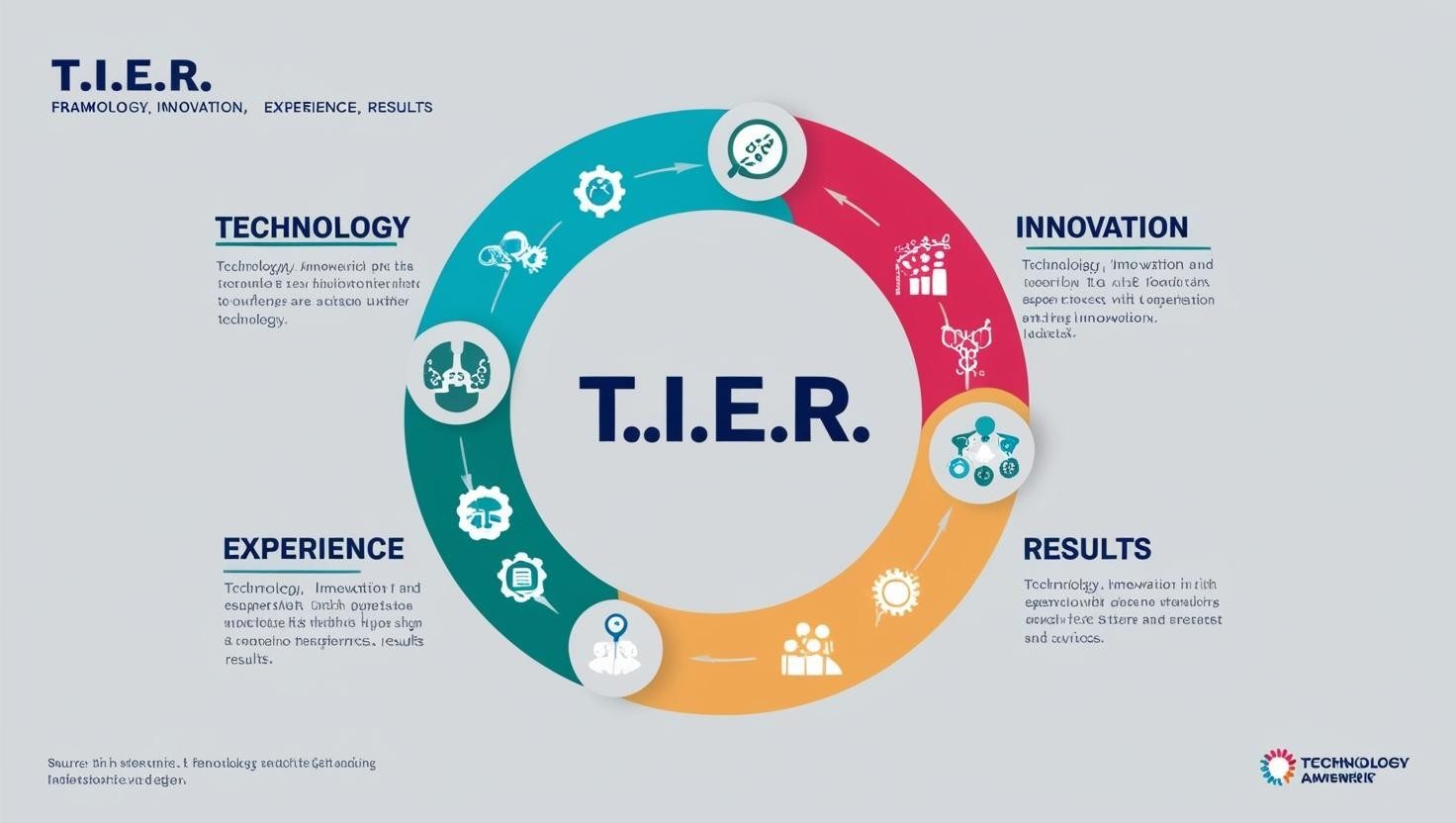
The T.I.E.R. Framework focuses on elevating services to avoid commoditization while demonstrating tangible value.
Technology
Integrate GenAI into the workflow, but don’t stop there—focus on proprietary extensions like personalization engines or sentiment analyzers.
Example: A GenAI-enabled dashboard that integrates campaign data and provides actionable insights tailored to each client’s KPIs.
Innovation
Create industry-first solutions that combine GenAI with other technologies (e.g., AR/VR, data clean rooms).
Example: Use GenAI to design hyper-targeted creative ads and pair them with attention-mapping technologies to optimize placements.
Experience
Highlight your agency’s expertise in pairing GenAI with human creativity. Showcase how this combination delivers a superior client and customer experience.
Example: Demonstrate case studies where GenAI saved costs while amplifying the emotional impact of campaigns.
Results
Shift to an outcome-driven approach where pricing reflects the tangible value delivered.
Example: Structure contracts to tie agency compensation to measurable performance metrics like engagement rates, ROI, or customer acquisition cost (CAC) improvements.
3. The C.A.P.E. Framework: Core, Augment, Personalize, Educate
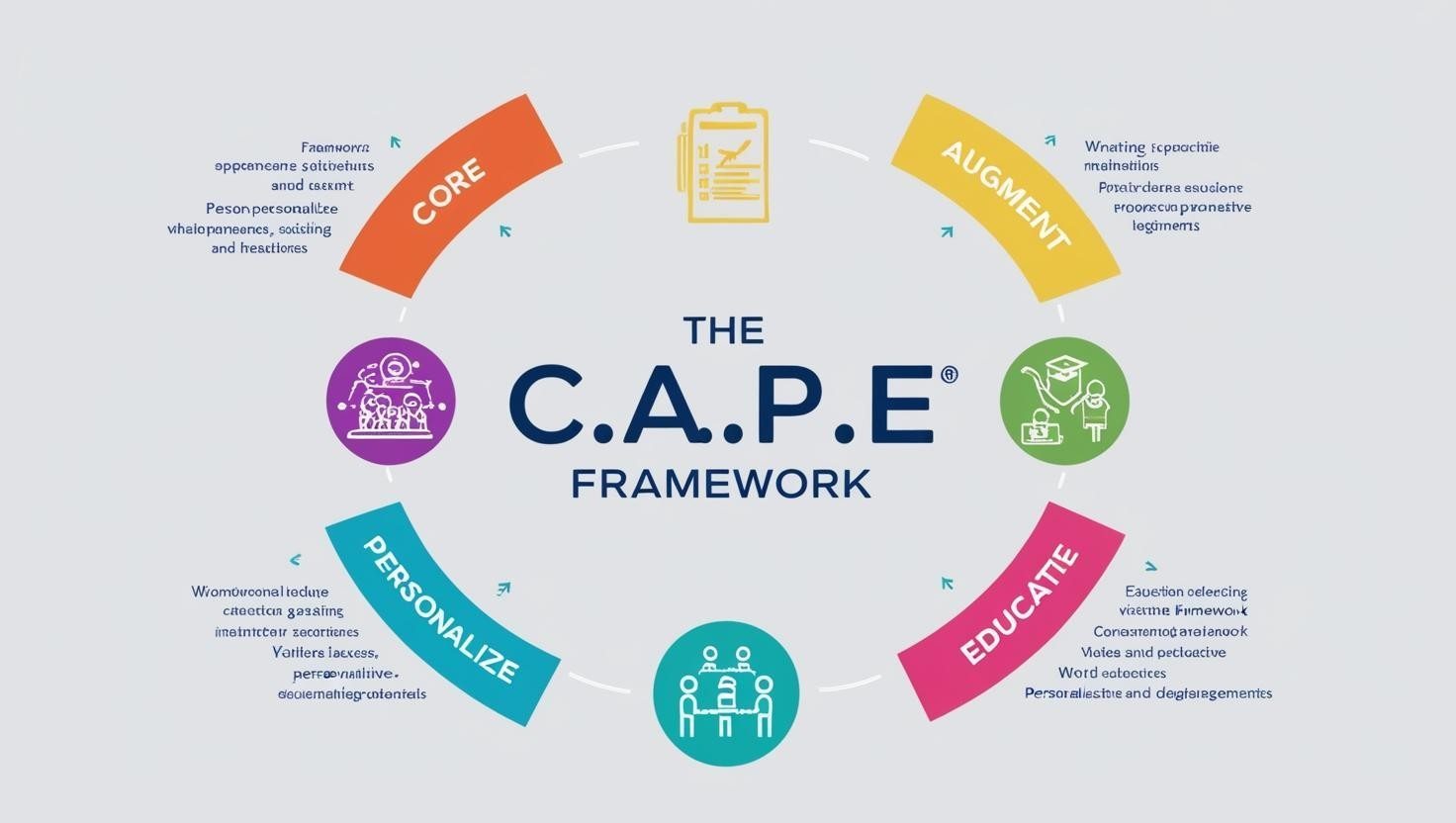
The C.A.P.E. Framework offers a holistic way to adapt operations and client interactions in response to pricing pressures.
Core (Preserve Your Core Strengths)
What to Do: Focus on what makes your agency unique—brand strategy, consumer insights, and creative storytelling.
How to Apply: While GenAI may handle execution, agencies should retain ownership of conceptualization, ensuring campaigns resonate on a cultural and emotional level.
Augment (Augment with GenAI, Don’t Replace)
What to Do: Use GenAI to complement, not substitute, human expertise.
How to Apply: Automate time-consuming tasks like resizing creatives or analyzing datasets. Free up human talent to focus on more complex, high-value contributions.
Personalize (Deliver Tailored Solutions)
What to Do: Shift focus to hyper-personalized strategies that reflect each client’s unique needs and audience characteristics.
How to Apply: Use GenAI to build nuanced customer profiles and create tailored creative campaigns. Demonstrate how such personalization leads to higher engagement and conversions.
Educate (Partner with Clients as Educators)
What to Do: Position your agency as a GenAI thought leader.
How to Apply: Offer training sessions and resources that help clients understand GenAI’s potential and limits. Example: Run workshops on integrating GenAI insights with traditional customer journeys for holistic marketing strategies.
4. The 4R Framework: Restructure, Reinvent, Reframe, Reinforce
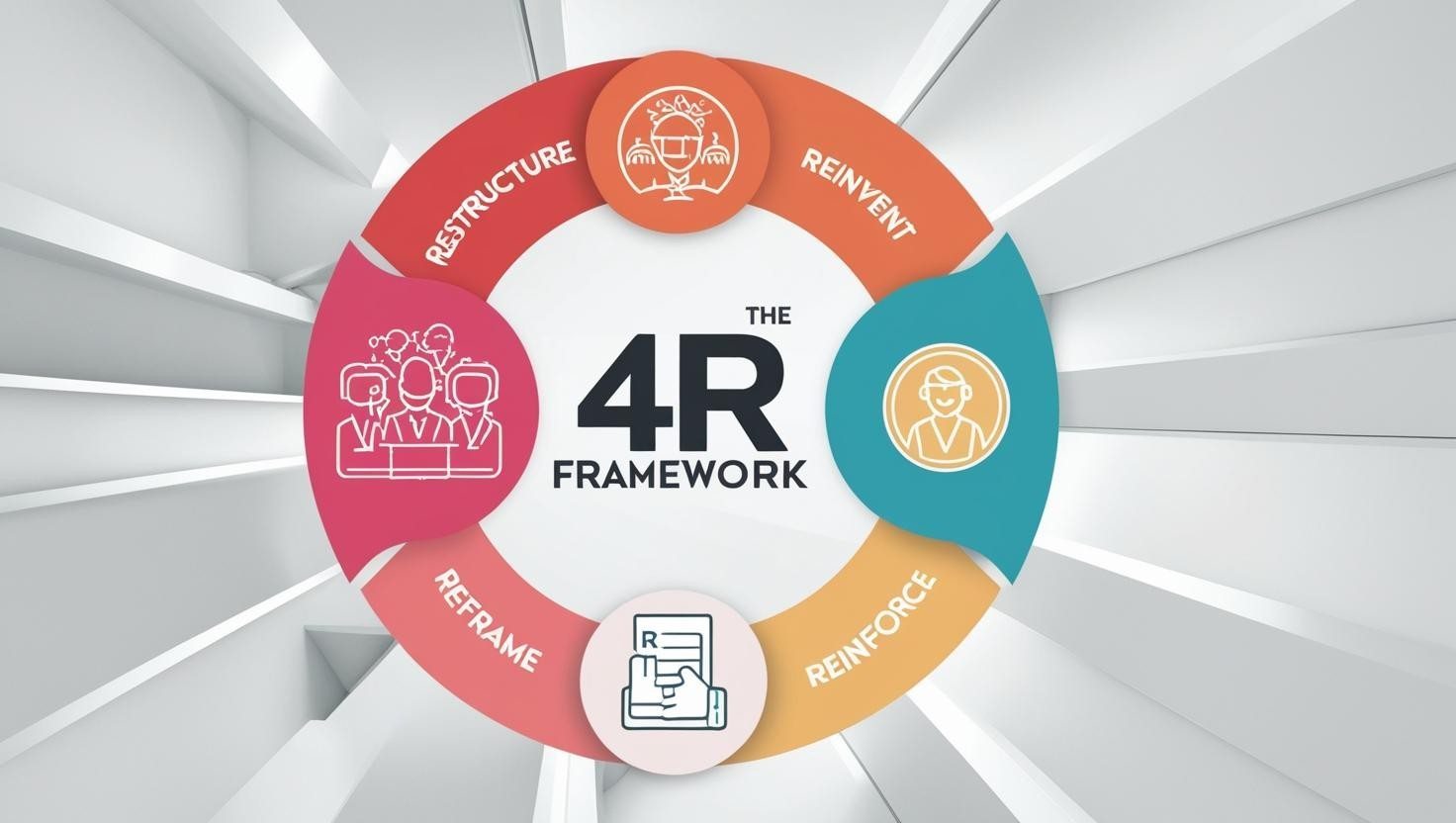
Restructure
Redefine internal operations to maximize efficiency while maintaining creativity.
Example: Establish GenAI-focused teams to handle execution, while senior teams concentrate on strategy and differentiation.
Reinvent
Innovate service offerings to include new GenAI-based solutions.
Example: Introduce dynamic creative optimization powered by GenAI, offering real-time ad variations based on audience behaviour.
Reframe
Change the conversation from cost reduction to value creation.
Example: Highlight how GenAI enhances your campaigns' impact rather than just reducing hours or costs.
Reinforce
Double down on trust, transparency, and ethics to build stronger client relationships.
Example: Ensure responsible GenAI usage, integrating privacy compliance (e.g., GDPR, DPDP) into every solution.
The Bigger Picture
The rise of GenAI in advertising is both an opportunity and a challenge. While it unlocks unprecedented efficiencies, it also reshapes the client-agency dynamic, forcing agencies to rethink how they deliver value.
The 2 key questions remain:
How can agencies embrace GenAI’s potential while preserving the value of human ingenuity and sustaining profitability?
Can agencies redefine their value in ways that GenAI cannot replicate, while still leveraging its strengths?
The answer lies in navigating this paradox with a balanced strategy that leverages technology, protects margins, and reinforces the irreplaceable human touch.
Agencies that adapt through frameworks like E.V.A.L., T.I.E.R., C.A.P.E., or 4R can position themselves as resilient, innovative, and indispensable partners in a GenAI-powered world.
Happy to hear your views.
Anil Pandit
Executive Vice President
Publicis Media
*Disclaimer: This post is for informational purposes only and does not endorse or disapprove of any specific tools, platforms, or technologies. The views and opinions expressed in this article are those of the author and do not reflect the official policy or position of the company he is employed in.
References :
FROM THE AUTHOR’S ARCHIVE
Original text from Anil Pandit’s article export. Claims and references reflect the time of writing.
Some original illustrations could not be recovered from the export’s image links.
View on LinkedIn ↗What does this mean for your business?
Bring the question into a focused advisory conversation.
Work with Anil ↗