

THE ARGUMENT IN BRIEF
This 2025 perspective considers Google’s decision to retain third-party cookies alongside a shift toward permissioned access to financial records in India. Anil argues that technical access does not replace consumer trust.
On April 22, 2025, Google quietly pulled the brakes on the cookieless future. Third-party cookies? They're staying—for now.
Meanwhile, in India, something extraordinary happened.
The CKYC Registry introduced a mandate requiring customers to actively approve, via OTP, every time a bank or financial institution wants to access their KYC data.One industry clings to old pipes.The other redraws the pipes altogether—with Consent as the central valve.
The contrast couldn't be sharper.And the message couldn't be clearer:
Cookies may be back. But unless we fix consent, advertising has no future.
Google's Move: A Flashback, Not a Future
Google cited “industry feedback,” "evolving regulation," and the "impact of AI" as reasons for this backpedal.But scratch beneath the surface and you see a different reality:
Privacy Sandbox solutions lacked true industry consensus.
Regulators were circling—suspicious of anti-competitive dynamics.
And many marketers, frankly, weren’t ready to reinvent.
So, cookies remain.Measurement stabilizes (for now).Targeting patches continue.Everyone breathes easier.
Or do they?
Because in every other part of the world—from Apple's IP masking to India's OTP consent—the tectonic plates are still shifting.
The signal loss isn't going away.
The consumer demands for privacy aren't softening.
The regulatory pressure isn’t relaxing.
Cookies are back. But trust isn’t.
Meanwhile in India: A Revolution of Consent
India’s banking sector did something advertising has never dared:
No silent tracking.
No assumptions hidden in 73-page policies.
No "accept all" nudges buried in dark UX.
Instead, every time a customer’s sensitive data is needed, they receive an OTP. They must actively, knowingly, approve. Every single time.
It’s painful for friction metrics.But it's magnificent for trust.
Because if banks need a customer’s active nod every time, why does AdTech assume eternal ‘yes’ from a one-time click hidden deep inside a privacy policy?
Consent Maturity vs Cookie Dependency
This moment forces us to ask: Are we mature enough to move from tracking by default to trust by design?
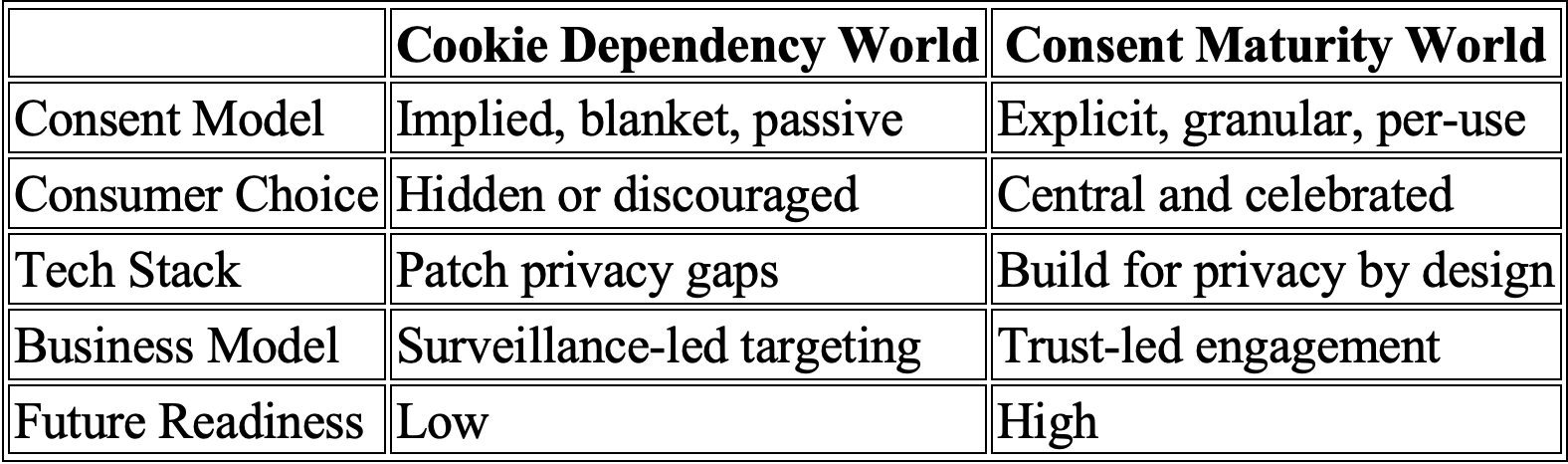
Today, BFSI is running laps around AdTech in Consent Maturity. And that's not just ironic. It's catastrophic.
What Marketers Must Understand Now
Third-party cookies might stay longer—but trust deficits will grow faster. Users are savvier. Regulators are stricter. Algorithms are evolving. You can't "target" your way out of a trust crisis.
Consent is not a checkbox. It’s a contract. It must be earned, renewed, respected. Real-time consent (like OTPs) isn't friction—it’s the foundation of durable relationships.
Zero-party data isn’t about gimmicks. It’s about genuine value exchange. Ask yourself: Are we inviting participation—or manipulating behaviour?
Signal loss is inevitable. Even with cookies, patchy signals, opaque data flows, and rising ad blockers will continue to erode precision. Durable growth comes from consented data, not opportunistic scraping.
A Crossroads Moment: Regression or Reinvention?
Google's move buys time.But it also risks lulling the industry into complacency again.
🧠 Imagine this:
A BFSI ecosystem where every login triggers real-time permission.
An advertising ecosystem still clinging to inferred consent and silent profiling.
Which one sounds ready for 2030?
The future belongs to those who rebuild consent architectures, not just retool tracking pipes.
Advertising was never supposed to be about surveillance.It was supposed to be about connection.
Cookies staying? That's a technical decision.
Consent maturing? That's a cultural evolution.
The cookie may survive a little longer. But only those who evolve consent will survive the future.
Advertising was built on reach. Modern advertising will be built on permission.
You can resurrect cookies. You can delay regulations. You can lobby for softer laws.
But unless you upgrade your Consent Maturity, your campaigns will be like sending invitations to an empty room.
The future doesn’t belong to those who track better. It belongs to those who ask better.
Anil Pandit
Executive Vice President
Publicis Media, India
*Disclaimer: This post is for informational purposes only and does not endorse or disapprove of any specific tools, platforms, or technologies. The views and opinions expressed in this article are those of the author and do not reflect the official policy or position of the company he is employed in.
FROM THE AUTHOR’S ARCHIVE
Original text from Anil Pandit’s article export. Claims and references reflect the time of writing.
View on LinkedIn ↗What does this mean for your business?
Bring the question into a focused advisory conversation.
Work with Anil ↗